

If you have diabetes and your shoulder has become painful and progressively stiff, frozen shoulder is one important possibility. The medical name is adhesive capsulitis. It is different from simply having a sore rotator cuff because the shoulder gradually loses both active motion and passive motion: you cannot move it normally, and an examiner cannot move it normally either.
The practical question is not just, “Do I have frozen shoulder?” It is also: What should I do next?
For most patients, treatment is nonsurgical. A useful plan often combines pain control with appropriately dosed motion and rehabilitation. In selected patients, an intra-articular corticosteroid injection can reduce pain enough to make stretching and physical therapy more productive. Hydrodilatation may be considered in some cases. Surgery is usually reserved for substantial stiffness that remains disabling despite a thoughtful nonsurgical program.
For people with diabetes, the plan deserves extra attention because diabetes is strongly associated with frozen shoulder and corticosteroid injections can temporarily raise blood glucose.
Key takeaway: Frozen shoulder is usually treated step by step. Confirm the diagnosis, rule out other shoulder problems, match rehabilitation intensity to the painful versus stiff phase, consider injection when pain is blocking progress, and reserve surgery for persistent, function-limiting cases that have not improved adequately with nonsurgical care.
Why is frozen shoulder more common with diabetes?
The association is real and substantial. A 2026 systematic review and meta-analysis found that people with diabetes had about 3.7 times higher odds of adhesive capsulitis than people without diabetes. The authors also emphasized that observational studies cannot prove that diabetes alone causes the condition and that other metabolic factors may contribute. (International Orthopaedics, 2026)
A large nationwide cohort published in 2023 also found increasing rates of adhesive capsulitis across normal glucose, prediabetes, newly diagnosed type 2 diabetes, and established type 2 diabetes groups. (Diabetes & Metabolism Journal, 2023)
Researchers believe chronic metabolic changes may affect collagen, connective tissue, inflammation, and fibrosis in the shoulder capsule. Clinically, the important point is simpler: if a patient with diabetes develops progressive painful shoulder stiffness, adhesive capsulitis should be considered early rather than assuming the problem is only bursitis or a rotator cuff strain.
What does frozen shoulder actually feel like?
Frozen shoulder often begins with pain before the stiffness becomes obvious. Common complaints include:
- Increasing night pain
- Pain reaching overhead or behind the back
- Difficulty putting on a shirt, bra, jacket, or seat belt
- Trouble washing or styling hair
- Progressive loss of external rotation
- Difficulty reaching into a cabinet or back pocket
- A sense that the entire shoulder is “stuck,” rather than simply weak
The classic examination finding is restriction of both active and passive range of motion, often with external rotation particularly limited.
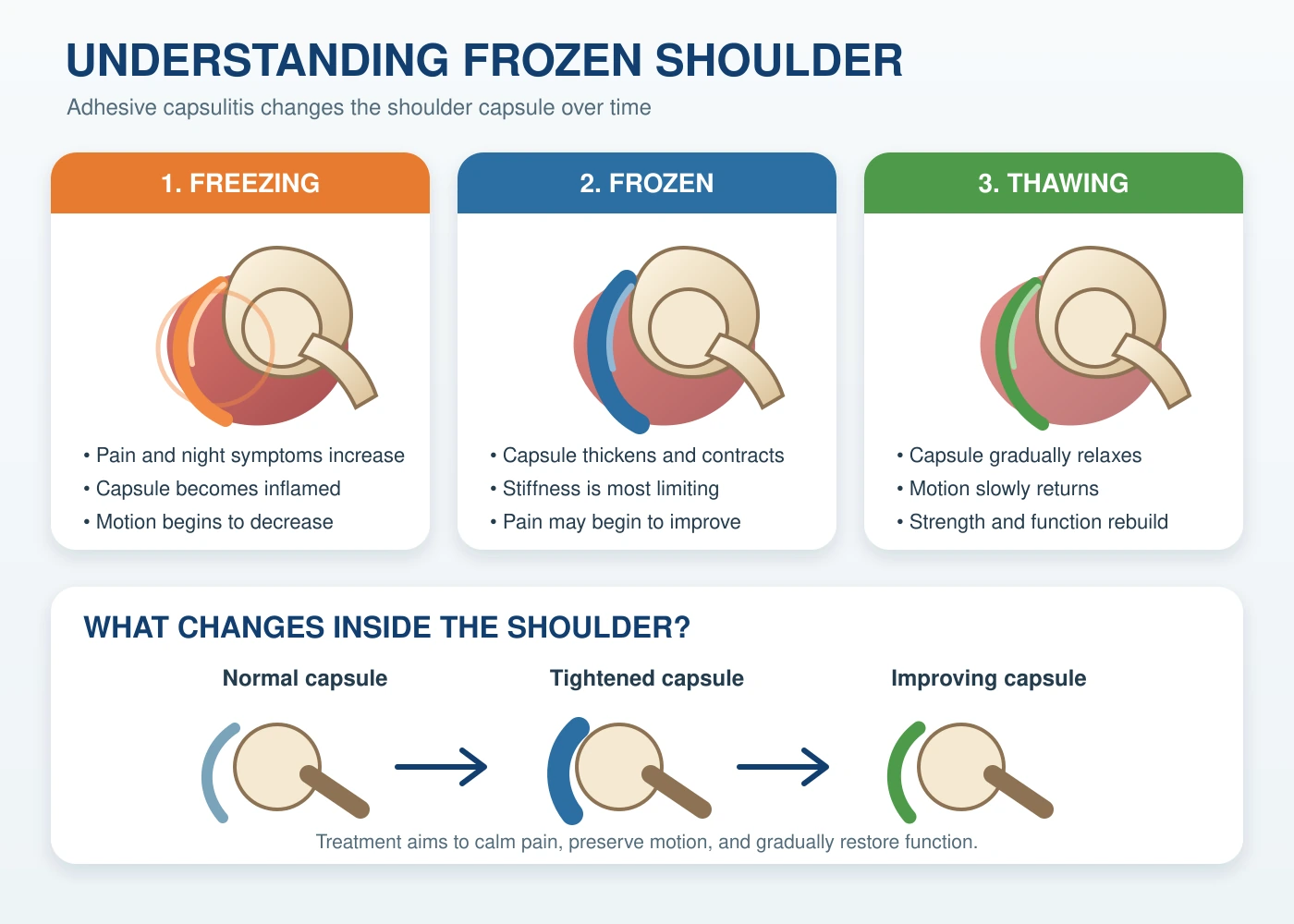
Frozen shoulder is often described in three overlapping phases:
- Freezing or painful phase: Pain increases while motion progressively decreases.
- Frozen phase: Stiffness becomes the dominant problem, although pain may still be present.
- Thawing phase: Motion gradually improves.
These are useful descriptions, not a stopwatch. Patients do not all move through the phases at the same speed, and treatment should be based on the actual irritability, stiffness, function, and goals of the person in front of us.
How is frozen shoulder different from a rotator cuff tear?
Both can hurt at night and make lifting the arm difficult, but the motion pattern is different.
With many rotator cuff tears, active motion may be weak or painful while passive motion remains relatively preserved. With adhesive capsulitis, the capsule itself is tight, so passive motion is restricted too.
The distinction matters because frozen shoulder, rotator cuff disease, shoulder arthritis, calcific tendinitis, cervical nerve problems, and occult fracture can require different treatment pathways. A patient can also have more than one problem at the same time.
Pacific Bone & Joint’s shoulder and elbow care is built around identifying the pain generator before escalating treatment.
Do I need an MRI for frozen shoulder?
Usually not just to prove the diagnosis.
A 2025 clinical practice guideline concluded that frozen shoulder is primarily a clinical diagnosis. Ultrasound and MRI can be useful as adjuncts, especially to rule out other conditions, but they should not replace the history and physical examination. (Annals of Rehabilitation Medicine, 2025)
Plain X-rays are often useful because they can identify glenohumeral arthritis, prior fracture, calcific deposits, or other bone abnormalities. An X-ray can look normal in a patient with true adhesive capsulitis.
Ultrasound or MRI becomes more useful when the history or examination raises concern for a substantial rotator cuff tear, biceps pathology, another soft-tissue problem, or when the clinical picture simply does not fit.
What is the best first treatment for frozen shoulder with diabetes?
There is no single treatment that is best for every stage and every patient. In most cases, the starting strategy is nonsurgical and combines:
- Education about the condition and expected course
- Pain control when needed and medically safe
- Gentle, regular range-of-motion work
- Physical therapy when stiffness or function warrants supervised progression
- Modification of activities that repeatedly provoke a major flare
- Attention to diabetes control and other medical conditions
A major mistake is treating every frozen shoulder with the same stretching intensity. During a highly painful, irritable phase, repeatedly forcing the shoulder to end range can make the patient miserable and may make it harder to stay consistent. As irritability decreases, the emphasis can gradually shift toward restoring motion, strength, and function.
How should physical therapy be used?
Physical therapy is not simply “stretch harder.” A good program is staged.
The 2025 guideline found that manual therapy combined with range-of-motion exercise may improve upper-extremity function and shoulder motion, and it also supports appropriately prescribed self-stretching. The evidence for any single exercise recipe is less certain, which is why treatment should be adjusted to the patient’s phase and response. (Annals of Rehabilitation Medicine, 2025)
Early therapy may focus on:
- Gentle assisted elevation
- External-rotation mobility within tolerable limits
- Pendulum or low-load motion
- Scapular mechanics
- Sleep positioning and symptom management
- Maintaining motion in the elbow, wrist, and neck
Later therapy may progress to:
- Longer-duration stretching
- Joint mobilization
- Rotator cuff and scapular strengthening
- Functional reaching
- Carrying and lifting progression
- Return to work, recreation, and sport
The goal is consistent improvement, not winning a stretching contest. Pacific Bone & Joint physical therapy can be integrated with orthopedic evaluation when the diagnosis, injection timing, or lack of progress needs reassessment.
When does a cortisone injection make sense?
An intra-articular corticosteroid injection can be especially useful when pain is severe enough that the patient cannot sleep, move the shoulder, or participate meaningfully in rehabilitation.
The 2025 guideline conditionally recommends intra-articular steroid injection to improve pain and upper-extremity function. It also supports combining steroid injection with physical therapy rather than viewing the two as competing treatments. (Annals of Rehabilitation Medicine, 2025)
A steroid injection does not mechanically “unstick” the capsule. Its value is primarily reducing inflammation and pain so movement may become easier and rehabilitation more tolerable.
What about blood sugar after a steroid injection?
This deserves a specific discussion in patients with diabetes. Local corticosteroid injections can cause temporary hyperglycemia, and the magnitude varies among patients.
In a prospective study of diabetic patients receiving shoulder corticosteroid injections, glucose elevations were larger and lasted longer in patients with poorer baseline glucose control and in insulin-dependent patients. (Archives of Bone and Joint Surgery, 2017)
That does not mean a person with diabetes can never receive a steroid injection. It means the decision should account for diabetes control, the severity of shoulder symptoms, the expected benefit, and a plan for glucose monitoring when appropriate. Patients should coordinate with the clinician managing their diabetes if medication adjustment may be necessary.
Does ultrasound guidance make the injection better?
Ultrasound can confirm anatomy and help place medication into the intended joint without radiation. However, the 2025 guideline found insufficient evidence that ultrasound-guided intra-articular injection is clinically superior to a well-performed landmark-guided injection in every patient. It recommends considering ultrasound guidance based on clinician expertise. (Annals of Rehabilitation Medicine, 2025)
From a practical orthopedic perspective, image guidance can be particularly useful when anatomy is difficult, prior injections have failed, another structure needs evaluation, or precise joint placement is important to the treatment plan.
What is hydrodilatation, and when should it be considered?
Hydrodilatation, also called hydrodistension, involves injecting fluid into the glenohumeral joint to distend the tight capsule, often together with local anesthetic and corticosteroid.
Evidence is mixed. A 2023 systematic review and meta-analysis found that hydrodilatation can provide at least transient improvements in disability and passive external rotation compared with intra-articular steroid injection alone, while emphasizing uncertainty about the durability and clinical importance of some effects. (British Medical Bulletin, 2023)
The 2025 guideline therefore takes a measured position: hydrodilatation can be considered together with intra-articular steroid injection for selected patients. (Annals of Rehabilitation Medicine, 2025)
It is not mandatory for every frozen shoulder. When it is used, rehabilitation afterward matters because any short-term gain in motion still has to be translated into useful movement and function.
What treatments have weaker or evolving evidence?
Patients understandably ask about every possible option. Some treatments may be reasonable in selected circumstances, but the evidence is not equally strong for all of them.
The current literature supports being cautious about assuming that more technology automatically means better treatment. Oral steroids, electrical stimulation, deep heat, nerve blocks, hyaluronic acid, PRP, and other interventions have varying levels of evidence and may have a role for selected patients. The best-established pathway remains diagnosis-based nonsurgical care, appropriately dosed rehabilitation, and selective use of intra-articular corticosteroid injection.
For someone with diabetes, treatment choice should also consider glucose control, kidney and cardiovascular disease, medication interactions, and other individual risks.
When is manipulation under anesthesia considered?
Manipulation under anesthesia, or MUA, forcefully moves the shoulder while the patient is anesthetized. It can improve motion, but it is not a trivial procedure.
The 2025 guideline notes that evidence supporting MUA is insufficient and that complications can include fracture and rotator cuff injury. It recommends considering intra-articular steroid injection before MUA. (Annals of Rehabilitation Medicine, 2025)
For that reason, MUA should not be treated as the automatic next step simply because a shoulder remains stiff for a few months.
When does frozen shoulder need surgery?
Most patients do not need surgery. Surgery becomes a more reasonable discussion when there is:
- Persistent, substantial loss of motion
- Continued pain or functional restriction despite an appropriate nonsurgical program
- Difficulty with work, hygiene, dressing, sleep, or essential daily activities
- A prolonged plateau despite adherence to treatment
- Another structural shoulder problem that also requires operative treatment
The typical operative option is arthroscopic capsular release, sometimes combined with gentle manipulation. Arthroscopy allows the surgeon to release selected contracted portions of the capsule under direct visualization and address other pathology when appropriate.
The decision should be individualized. Surgery is not required just because the diagnosis has lasted a certain number of months.
What can I do at home without making it worse?
During a painful phase:
- Perform gentle motion frequently rather than one aggressive stretching session
- Stop using “no pain, no gain” as the rule
- Support the arm with a pillow when sleeping on the opposite side
- Consider a slightly reclined sleep position if lying flat is difficult
- Keep frequently used objects in an easy reaching zone
- Use heat before stretching if it improves comfort
- Use ice afterward if exercise triggers soreness
- Track whether a stretch settles quickly or causes hours of increased pain
As pain improves, the shoulder can usually tolerate progressively greater stretch and strengthening loads.
When should shoulder stiffness be evaluated promptly?
Frozen shoulder usually develops gradually. Seek prompt medical evaluation if symptoms include:
- Fever, redness, warmth, or rapidly increasing swelling
- A major fall or injury
- Sudden inability to lift the arm after trauma
- New arm or hand weakness or numbness
- Severe pain after surgery or injection
- Chest pain, shortness of breath, sweating, or other symptoms that could represent a non-orthopedic emergency
Those findings should not automatically be attributed to adhesive capsulitis.
A practical treatment sequence for frozen shoulder and diabetes
In my clinical practice, I think about frozen shoulder as a diagnosis and sequencing problem rather than a race to the most aggressive intervention.
A reasonable sequence is often:
- Confirm that the pattern is truly adhesive capsulitis.
- Obtain X-rays and use ultrasound or MRI selectively when another diagnosis needs to be excluded.
- Control pain enough to allow useful motion.
- Start a phase-appropriate home program and physical therapy when needed.
- Consider an intra-articular corticosteroid injection when pain is blocking sleep or rehabilitation, while planning for glucose monitoring in patients with diabetes.
- Consider hydrodilatation or other interventions selectively if progress stalls.
- Discuss arthroscopic capsular release only when persistent disability remains significant despite an appropriate nonsurgical course.
The exact order can change based on the patient’s pain level, medical conditions, work demands, goals, and response to treatment.
Frozen shoulder care in Hawaiʻi
If shoulder pain and stiffness are making it difficult to sleep, dress, work, exercise, or reach normally, an evaluation can help determine whether the problem is adhesive capsulitis, rotator cuff disease, arthritis, a nerve problem, or something else.
Pacific Bone & Joint evaluates shoulder conditions for patients in Hawaiʻi and can coordinate orthopedic diagnosis, imaging, injection treatment, and rehabilitation when appropriate.
Request an appointment if progressive shoulder stiffness is interfering with everyday life or if you are not improving with your current treatment plan.
This article is for general education and does not replace an individual medical evaluation. Treatment recommendations may differ for people with diabetes, kidney disease, cardiovascular disease, anticoagulant use, prior surgery, or other medical conditions.
Sources and further reading
- Lee BC, et al. Clinical Practice Guidelines for Diagnosis and Non-Surgical Treatment of Primary Frozen Shoulder. Annals of Rehabilitation Medicine. 2025. Full text
- Hernigou P, Scarlat MM. The diabetic shoulder: association between diabetes mellitus and adhesive capsulitis — a systematic review and meta-analysis. International Orthopaedics. 2026. PubMed
- Kim JH, et al. The Risk of Shoulder Adhesive Capsulitis in Individuals with Prediabetes and Type 2 Diabetes Mellitus: A Longitudinal Nationwide Population-Based Study. Diabetes & Metabolism Journal. 2023. PubMed
- Poku D, et al. Efficacy of hydrodilatation in frozen shoulder: a systematic review and meta-analysis. British Medical Bulletin. 2023. PubMed
- Kirker K, et al. Manual therapy and exercise for adhesive capsulitis: a systematic review with meta-analysis. Journal of Manual & Manipulative Therapy. 2023. PubMed
- Aleem AW, et al. Blood Glucose Levels in Diabetic Patients Following Corticosteroid Injections into the Subacromial Space of the Shoulder. Archives of Bone and Joint Surgery. 2017. PubMed
