
Our Decision Framework
Start with the diagnosis — not the syringe
A biologic should be chosen because it fits the tissue problem and the evidence, not because it appears at the top of a treatment menu.
Identify the pain generator
History, examination and imaging help determine whether the problem is cartilage, tendon, ligament, meniscus, subchondral bone, alignment or advanced arthritis.
Ask whether biology can help
We review the evidence for that diagnosis and whether PRP, BMAC, laser, rehabilitation or another strategy has a plausible role.
Account for mechanics
Biology cannot reliably correct severe deformity, instability, a displaced mechanical lesion or end-stage joint destruction.
Choose the lowest-burden effective option
If a less invasive treatment is reasonable, we start there. If surgery offers the more predictable result, we explain why rather than selling another injection.
Platelet-Rich Plasma (PRP)
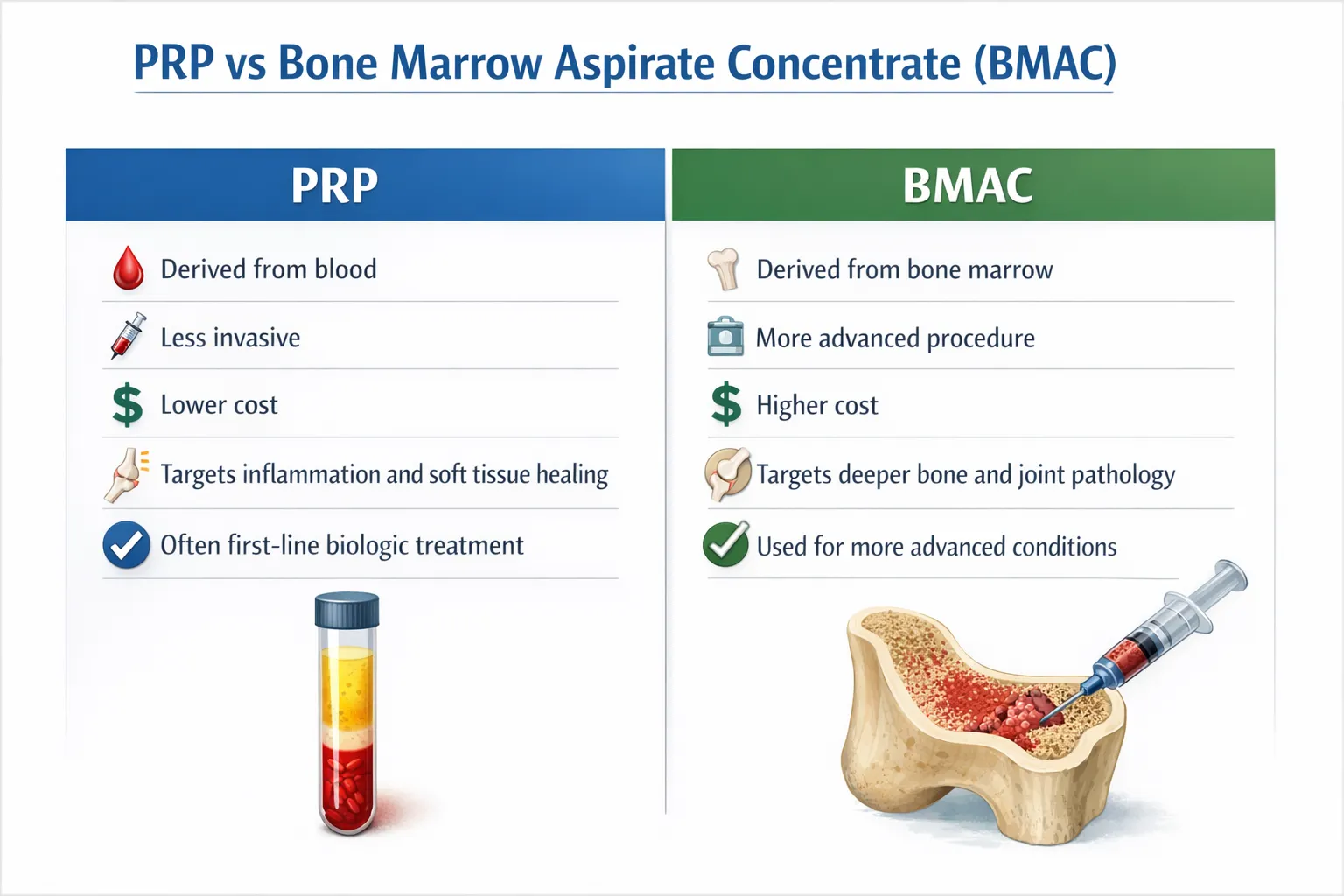
PRP is prepared from your own blood and concentrates platelets and their signaling proteins. It has the larger clinical evidence base of the two injectable orthobiologics we discuss most often. Importantly, PRP is a category rather than a standardized drug: dose and formulation vary.
Commonly considered for
- Knee osteoarthritis
- Tendon disorders
- Selected ligament, joint and sports injuries
Bone Marrow Aspirate Concentrate (BMAC)
BMAC is prepared from bone marrow and contains a mixed population of cells, platelets and signaling proteins. It requires a marrow harvest and is not simply the “premium” version of PRP. Current comparative evidence has not consistently shown clinically meaningful superiority over PRP.
May be considered for
- Selected knee osteoarthritis cases
- Subchondral bone marrow lesions
- Selected joint or soft-tissue problems after individualized review
Beyond Injections
Joint preservation is bigger than PRP and BMAC
Class IV MLS Laser Therapy
Photobiomodulation using synchronized near-infrared wavelengths may help with pain, inflammation and recovery in selected musculoskeletal conditions. It is an adjunct — not a substitute for correcting a structural problem.
More about MLS laser therapy →Cartilage Restoration
MACI, osteochondral grafting and other cartilage-restoration procedures address discrete structural cartilage defects. These are fundamentally different from an injection and may be more appropriate when there is a repairable focal lesion.
More about cartilage restoration →Before You Pay for a Biologic
Questions worth asking any regenerative-medicine clinic
What exactly is being injected? Your own blood, your own marrow, donor tissue, an exosome product, or something else?
If it is PRP, what formulation is it? Platelet dose, concentration and leukocyte profile can vary greatly between systems.
What evidence supports this treatment for my diagnosis? Evidence for knee OA should not automatically be applied to a tendon, spine or hip problem.
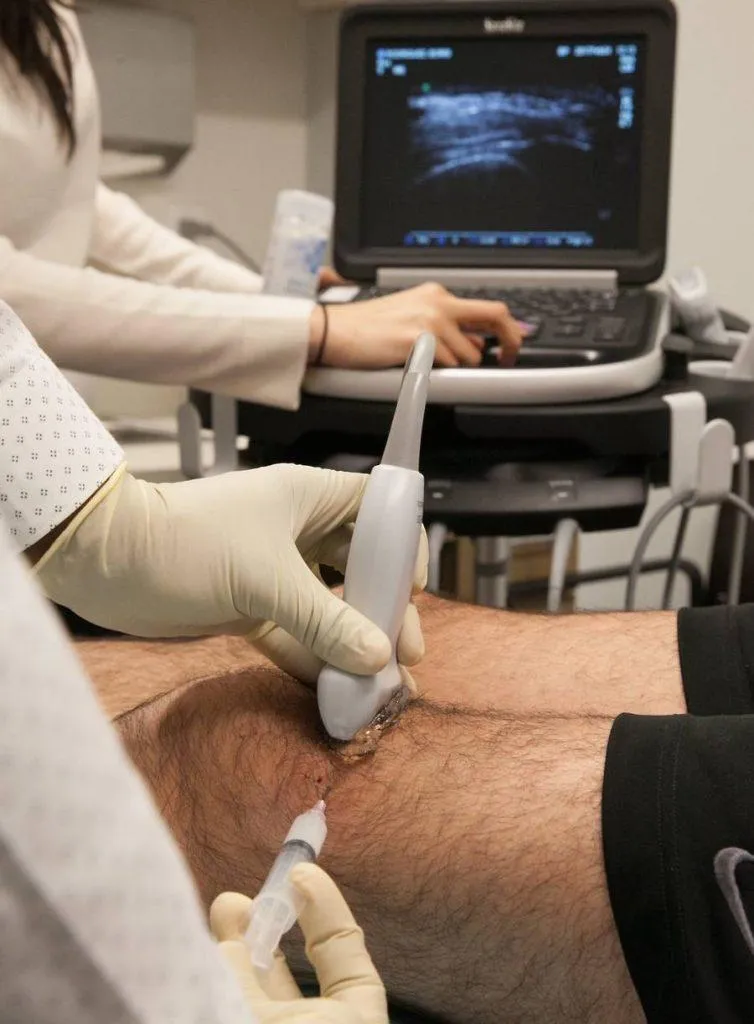
How will the target be confirmed? For many joints and soft tissues, real-time ultrasound improves targeting and documents needle placement.
What would make you recommend against the injection? A trustworthy consultation should include reasons not to spend money on a biologic.
FDA & Marketing Claims
“Regenerative” does not mean FDA-approved for arthritis
FDA has specifically warned consumers about unapproved regenerative medicine products marketed for orthopedic conditions. Donor-derived products promoted as umbilical-cord, Wharton’s jelly, amniotic, exosome or “stem-cell” injections should not be assumed to be equivalent to same-day autologous PRP or marrow concentrate — and they should not be assumed to be approved simply because they are offered in a medical office.
We focus on treatments we can describe accurately: what the material is, where it comes from, how it is prepared, the evidence for the specific orthopedic diagnosis, and the limitations of that evidence.
When mechanics matter more than biology
Advanced arthritis, major deformity, instability, displaced tears and other structural problems can reach a point where another injection is less predictable than correcting the mechanical problem. Because our practice includes both joint preservation and reconstructive surgery, we can discuss both sides of that decision.
The evidence in one sentence
PRP has a growing evidence base with outcomes influenced by formulation and diagnosis; BMAC can improve symptoms but has not consistently demonstrated clinically meaningful superiority over PRP or other injections; neither should be marketed as a guaranteed way to regrow an arthritic joint.
2-Minute Check
Am I a candidate for regenerative medicine?
Answer a few quick questions. This is educational and is not a diagnosis — only an evaluation can tell for sure.
Do you have early arthritis or a tendon injury?
Would you like to explore non-surgical options before considering surgery?
Have you either not yet tried, or not responded to, other conservative care?
You may be a strong candidate.
Your answers suggest regenerative medicine could be a good fit. The next step is a simple evaluation, where we'll confirm with an exam and imaging and review every option with you — surgical and non-surgical.
This tool is educational and not a diagnosis. Not everyone is a candidate; only a clinical evaluation can determine what's right for you.
You might be a candidate — let's talk.
Some of your answers point toward regenerative medicine, but the right path depends on the details. A short evaluation will give you a clear, honest answer and a plan.
This tool is educational and not a diagnosis. Not everyone is a candidate; only a clinical evaluation can determine what's right for you.
Let's take a closer look.
Your answers don't point clearly to regenerative medicine yet — but that doesn't mean we can't help. We'll evaluate what's going on and point you to the care that fits, often starting with non-surgical options.
This tool is educational and not a diagnosis. Not everyone is a candidate; only a clinical evaluation can determine what's right for you.
Answer all 3 questions to see your result.
Rehabilitation & Recovery
Physical therapy for orthobiologic treatment
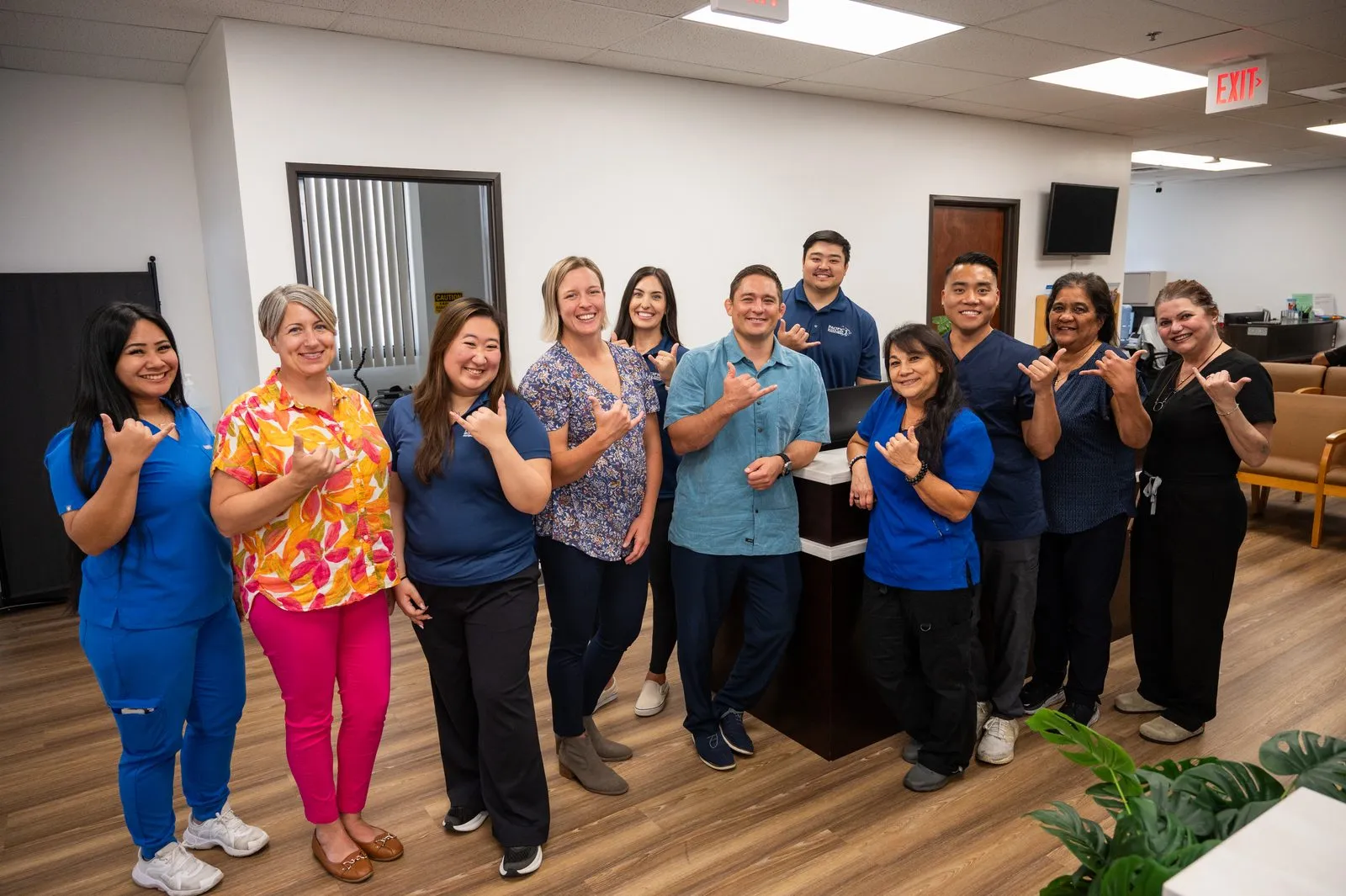
PB&J Physical Therapy works inside our Honolulu and Waipahu/Kunia clinics, so your rehabilitation is planned with the same orthopedic team that treats you. Many orthopedic problems improve with therapy alone, and Hawai‘i allows direct access to physical therapy without a physician referral (some plans still require one for coverage).
PB&J Physical Therapy →Questions, Answered
Regenerative medicine FAQ
What does regenerative medicine mean in orthopedics?+
In orthopedic practice, the term usually refers to treatments intended to influence the biologic environment of injured or degenerative tissue. That can include autologous orthobiologics such as PRP and bone marrow aspirate concentrate. We use the term carefully because “regenerative” does not mean that every treatment has been proven to regenerate normal cartilage, tendon or bone.
What is an orthobiologic?+
An orthobiologic is a biologically derived material used to support the treatment of musculoskeletal problems. PRP is prepared from your blood; BMAC is prepared from your bone marrow. These products are not interchangeable, and even two PRP preparations can be very different.
Are PRP and BMAC the same as donor “stem cell” or exosome injections?+
No. PRP and BMAC are prepared from the patient’s own blood or marrow. Donor-derived products marketed as amniotic, umbilical-cord, Wharton’s jelly, exosome or similar “stem cell” injections are different products with different regulatory and evidence questions. FDA has warned consumers about unapproved regenerative products marketed for orthopedic conditions.
Do PRP or BMAC cure arthritis?+
No. They may improve pain and function in selected patients, but they do not reliably restore a normal arthritic joint surface and should not be sold as a cure.
What's the difference between PRP and BMAC?+
PRP is prepared from blood and has the larger clinical evidence base. BMAC is prepared from bone marrow, contains a broader mixture of cells and signaling factors, and requires a marrow-harvest procedure. Comparative studies have not consistently shown BMAC to be clinically superior to PRP, so it should not be viewed as an automatic upgrade.
How do you decide which treatment is appropriate?+
We start with the diagnosis, imaging, mechanical alignment or structural damage, prior treatment, goals and the evidence for that specific tissue problem. Sometimes the answer is PRP or BMAC; sometimes it is physical therapy, laser, cartilage restoration, osteotomy, arthroscopy or joint replacement.
Why use ultrasound guidance?+
Ultrasound lets the clinician see the anatomy and needle in real time. For many joints and soft-tissue targets, that improves confidence that the treatment reaches the intended location.
Are regenerative treatments covered by insurance?+
PRP and BMAC are usually not covered by insurance. We explain expected costs before treatment and do not recommend a more expensive biologic simply because it costs more.
Explore Related Care
Related care
PRP Injections
Blood-derived orthobiologic with an evidence-aware focus on formulation and dose.
Explore →BMAC
Marrow-derived orthobiologic for selected cases.
Explore →Cartilage Restoration
MACI, osteochondral grafting and other joint-preservation procedures.
Explore →Physical Therapy
Progressive loading and rehabilitation to support recovery.
Explore →Patient Reviews
What patients say
4.9 average across 509 ratings on 8 review sites
“Pacific Bone and Joint, located in the Ala Moana Medical Building, has an absolutely amazing staff of medical professionals. Cindy is so helpful and knowledgeable in preparing you for procedures. I received a gel injection treatment and the entire staff was so friendly and professional.”
— Gareth Y.· Google review
Review excerpts reflect individual patient experiences and may be lightly condensed. Results vary.
Find out what actually fits your diagnosis.
A good regenerative-medicine consult may end with PRP, BMAC, physical therapy, laser, cartilage restoration, another joint-preservation procedure — or a recommendation not to spend money on a biologic at all.
PRP and BMAC are generally self-pay. Evidence varies by diagnosis and preparation. Individual results vary. This page is educational and is not a substitute for medical advice.