Island Care, World-Class Orthopedics · A full-service orthopedic group · Oahu & Big Island News Careers Contact Patient Portal (808) 439-6201

Class IV · Non-Invasive · Photobiomodulation

MLS Laser Therapy

MLS laser therapy uses synchronized near-infrared light as a non-invasive adjunct for musculoskeletal pain and recovery. At Pacific Bone & Joint, we use it as part of an orthopedic plan—not as a stand-alone cure.

Request a Consult → Call (808) 439-6201

Evidence is condition-specific and individual results vary. We pair laser therapy with diagnosis-driven care, rehabilitation and other proven treatments.

Common goals

  • Reduce musculoskeletal pain
  • Calm inflammation and swelling
  • Support recovery after injury or surgery
  • Complement physical therapy, PRP or BMAC when appropriate

Understanding the Technology

What “Class IV” and photobiomodulation mean

Class IV describes laser power and safety requirements; it is not a score of clinical effectiveness. MLS therapy uses that light for photobiomodulation (PBM)—a process in which red or near-infrared photons interact with tissue and may alter cellular signaling.

1

Light reaches tissue

Near-infrared light is delivered through the skin to the targeted musculoskeletal tissues.

2

Cells respond to photons

Photobiomodulation research suggests light can influence mitochondrial activity, ATP production and cell signaling.

3

Pain and inflammatory signaling may change

Those cellular effects may influence local circulation, inflammatory signaling and pain processing. The clinical effect depends on the diagnosis, dose and treatment protocol.

808 nm · Continuous

Biostimulation / inflammatory signaling

MLS device literature associates the continuous 808 nm wavelength with circulation, cellular metabolism and inflammatory signaling.

905 nm · Pulsed

Pain modulation

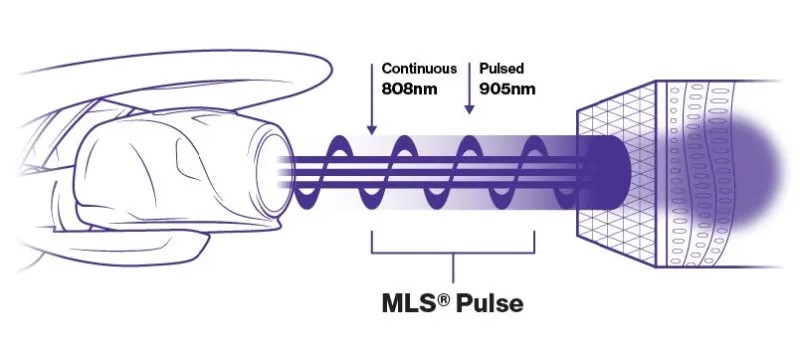
The pulsed 905 nm wavelength is used for deeper tissue delivery and is described as influencing nociceptive pain signaling. MLS synchronizes both wavelengths in one treatment pattern.

What to Expect

Comfortable, brief and non-invasive

01

Brief treatment

A treatment area commonly takes about 5–15 minutes. There are no needles or incisions.

02

Targeted light energy

The MLS system delivers synchronized 808 nm and 905 nm infrared wavelengths over the treatment area.

03

Back to your day

Most patients need no recovery period after a session and can return to normal daily activity.

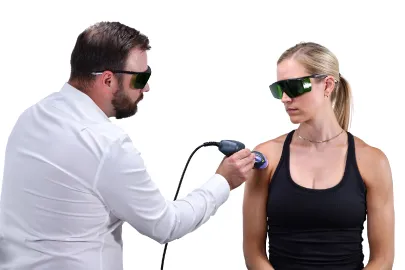
A clinician applies a handheld MLS laser to a patient's shoulder; both wear protective glasses
Handheld mode: the applicator is guided over the treatment area with protective eyewear.
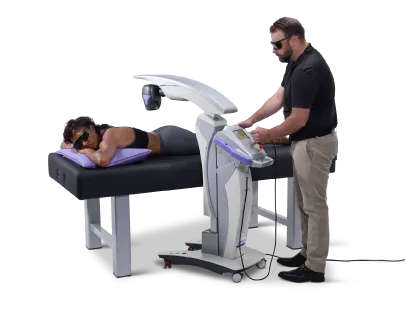
An MLS robotic laser unit positioned over a patient on a treatment table while a clinician operates the console
Robotic scanning can deliver treatment over a defined area without an injection or incision.
Diagram of the MLS pulse: a continuous 808 nm emission and a pulsed 905 nm emission delivered together
MLS combines a continuous 808 nm emission with a pulsed 905 nm emission in a synchronized pattern.

Common Orthopedic Uses

Where MLS laser may fit

Laser therapy is not equally supported for every diagnosis. We first identify the source of your symptoms, then decide whether PBM is a reasonable adjunct.

Knee osteoarthritis

An adjunct for pain and function, usually paired with exercise or physical therapy.

Hip pain & bursitis

May be considered for selected soft-tissue and degenerative hip symptoms.

Shoulder & rotator cuff pain

Used for selected tendinopathy, bursitis and overuse conditions.

Tendinopathy

Commonly used for Achilles, patellar and elbow tendon symptoms.

Sports injuries

May support a rehabilitation plan for strains, sprains and soft-tissue injuries.

Muscle strains & contusions

A non-invasive option used alongside activity modification and rehabilitation.

Plantar fasciitis

Sometimes incorporated into treatment for persistent heel and plantar fascia pain.

Low-back pain

Evidence suggests possible pain benefit in selected chronic low-back pain patients.

Post-surgical recovery

Photobiomodulation is being studied as an adjunct for pain, swelling and early rehabilitation after orthopedic surgery.

Nerve-related pain

May be considered in selected neuropathic or nerve-irritation symptoms as part of a broader diagnostic plan.

Carpal tunnel symptoms

May help symptoms in selected cases, but it does not physically release a compressed median nerve.

PRP & BMAC support

Some practices use laser therapy around orthobiologic injections; evidence for added long-term benefit is still developing.

Potential Effects

What laser therapy is trying to accomplish

These are proposed or reported biological effects—not promises of a specific clinical result.

1

Pain modulation

MLS device literature and photobiomodulation studies describe effects on pain signaling and local tissue sensitivity.

2

Inflammation & swelling

Photobiomodulation may influence inflammatory signaling and local fluid movement in some conditions.

3

Cellular energy

A proposed mechanism involves mitochondrial responses and increased ATP availability for cellular processes.

4

Local circulation

Therapeutic infrared laser devices are cleared for temporary increases in local blood circulation.

5

Rehabilitation support

The strongest role is usually as an adjunct to exercise, physical therapy and condition-specific orthopedic care.

6

No injections or medication

Treatment is non-invasive and drug-free, making it an option for patients looking for an additional non-pharmacologic modality.

Watch: how MLS laser therapy works. Manufacturer video; the strength of evidence varies by condition.

MLS Laser Therapy at a Glance

Treatment is individualized. These figures describe common protocols rather than a guarantee of what any one patient will need.

5–15 min
Typical Time Per Area
Brief, non-invasive treatment with no incision or injection
6–12
Common Treatment Range
Acute problems often use fewer sessions; chronic conditions may need a longer course
808 + 905 nm
Synchronized Wavelengths
Continuous and pulsed near-infrared emissions delivered together by the MLS system
0
Needles or Incisions
A non-pharmacologic adjunct that can be paired with physical therapy and other orthopedic care

What the Research Says

Promising, but condition-specific

There is meaningful human research on photobiomodulation and high-intensity laser therapy, but protocols and devices differ. We do not treat every positive laser study as proof that every MLS protocol will produce the same result.

2023 systematic review & meta-analysis

High-intensity laser therapy for symptomatic knee osteoarthritis

Nine studies were included. The review found short-term pain improvement versus sham or conventional therapy, with benefit also seen when laser was combined with exercise. This literature evaluates high-intensity laser therapy broadly and is not specific to every MLS device or protocol.

Read the study →

2025 randomized double-blind study

MLS laser for chronic low-back pain

Thirty patients were studied. After 12 MLS sessions, the laser group had a larger reduction in pain scores than the exercise group. The study was small, and the authors specifically called for larger trials.

Read the study →

2026 systematic review

Photobiomodulation after hip and knee replacement

Four randomized trials with 133 total participants suggested promising short-term improvements in pain, edema and some functional outcomes after arthroplasty. The review concluded that treatment protocols remain heterogeneous and the evidence is not yet conclusive.

Read the study →

FDA context: FDA 510(k) clearance for ASA 808/905 nm therapeutic laser families includes temporary relief of muscle and joint pain and stiffness, arthritis pain or muscle spasm, temporary increase in local blood circulation, and muscle relaxation. FDA clearance is not the same as proof that the device heals every orthopedic condition.

View FDA 510(k) summary →

Patient Reviews

What patients say

“I have had knee problems for years as a powerlifter, plus a recent wrist strain. I had laser treatments to my knee and wrist — this was my first session and I felt a huge difference! My joints feel amazing.”

— Luvi· Google review

Review excerpts reflect individual patient experiences and may be lightly condensed. Results vary.

Questions, Answered

Frequently asked questions

What does “Class IV” laser mean?+

Class IV is a laser safety/power classification, generally used for lasers above 500 mW. It does not by itself prove that a treatment works. High-power therapeutic lasers must be used with appropriate protocols and eye protection.

What is photobiomodulation?+

Photobiomodulation (PBM) is the use of red or near-infrared light to influence cellular activity. Proposed mechanisms include mitochondrial signaling and ATP production, with downstream effects on pain and inflammatory signaling. The clinical evidence varies substantially by condition and treatment protocol.

What is different about MLS laser therapy?+

MLS stands for Multiwave Locked System. The system synchronizes an 808 nm continuous emission with a 905 nm pulsed emission. Device literature describes complementary effects from the two wavelengths, while the clinical benefit still depends on the condition being treated.

Does MLS laser therapy hurt?+

Most patients experience little or no discomfort. Treatment is non-invasive and does not require needles or an incision. Protective eyewear is used because this is a high-power laser.

How long is each session?+

A treatment area commonly takes about 5–15 minutes. The exact time depends on the body area, diagnosis and treatment settings.

How many sessions will I need?+

Protocols vary. Many practices use approximately 6 sessions for acute problems and 10–12 for longer-standing conditions, but we individualize the course based on your diagnosis and response.

Can laser therapy replace surgery for arthritis?+

No. Laser therapy may help symptoms and function for some patients, but it does not restore severely damaged cartilage or correct structural problems that require surgery. We use it as one option within a broader orthopedic treatment plan.

Can MLS laser therapy be used with PRP or BMAC?+

Yes, it can be used as an adjunct around orthobiologic treatment. Some practices use PBM to improve comfort and support recovery, but evidence that the combination produces superior long-term outcomes is still developing. We do not present laser therapy as a way to guarantee a PRP or BMAC result.

Is MLS laser therapy FDA approved?+

Therapeutic laser devices are generally marketed through FDA 510(k) clearance rather than a drug-style “approval.” For example, FDA-cleared ASA 808/905 nm laser families have indications that include temporary relief of muscle and joint pain and stiffness, arthritis pain or muscle spasm, temporary increases in local circulation, and muscle relaxation. Clearance and indications vary by specific device model.

Is it covered by insurance?+

Coverage varies and many plans treat musculoskeletal laser therapy as a non-covered service. Our team will explain any patient cost before treatment.

Could MLS laser fit your recovery plan?

We’ll identify what is actually causing your symptoms and tell you whether laser therapy is worth adding—or whether another treatment makes more sense.

Request a Consult → Call (808) 439-6201
Call Schedule Appointment