
 Written and medically reviewed by Paul Norio Morton, MD, FAAOS, FAAHKS · Board-certified orthopedic surgeon · Last reviewed July 2026
Partial vs. Total
Two good operations — for two different knees
The knee has three compartments. Where your arthritis lives — one compartment or several — is what decides between a partial and a total replacement. Because we offer both, the recommendation is driven by your imaging, not by the tool.
Partial knee replacement
- Resurfaces only the worn compartment
- Preserves healthy bone, cartilage, and all knee ligaments — including the ACL
- Smaller incision and less tissue disturbed
- Often a faster early recovery; many patients report a more natural-feeling knee
Best for arthritis confined to a single compartment with intact ligaments.
Total knee replacement
- Resurfaces all compartments of the knee
- The right tool when arthritis is widespread
- A well-established operation with durable results
- Also robotic-assisted and muscle-sparing at PB&J
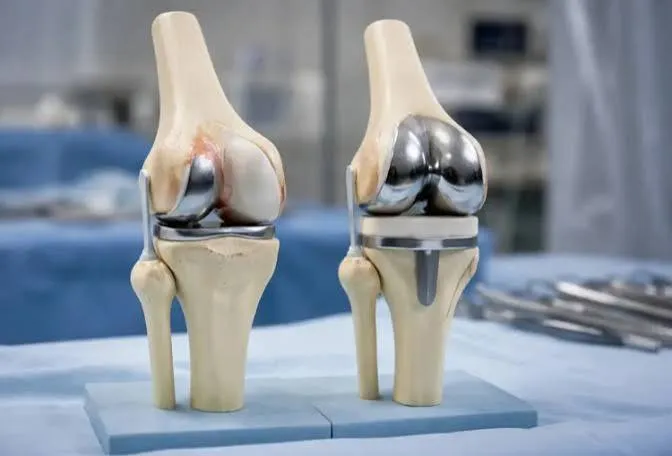
One honest caveat: a partial knee does not stop arthritis from developing elsewhere in the knee over time. If it does, a partial can be converted to a total knee replacement — careful patient selection is how we keep that risk low.
Robotic-Assisted Precision
Millimeters matter in a partial knee
Because a partial knee fits an implant into one compartment while preserving everything around it, precise sizing and alignment matter even more than in a total knee. That's why Dr. Morton performs partial knee replacement with robotic assistance: a plan is built from your imaging before surgery, and real-time data helps position the implant accurately for your anatomy.
On the Big Island, partial knees are performed at Hilo Community Surgery Center with the CT-based MAKO™ system — robotic hip, total and partial knee, outpatient and close to home. On Oahu, Dr. Morton operates at The Queen's Medical Center and Adventist Health Castle, with the robotic platform matched to your procedure and venue.
The robot assists with planning and alignment — Dr. Morton controls every step. It does not perform surgery on its own or guarantee a specific outcome. MAKO™, ROSA®, and CORI® are trademarks of their respective manufacturers.
Why patients ask about partial knees
- Keeps your ACL and other ligaments, which help the knee feel like your own.
- Less bone removed — healthy compartments are left untouched.
- Smaller incision and less soft-tissue disruption, which often means a faster early recovery.
- Cementless option — a press-fit implant your own bone grows into, well-suited to active patients.
Recovery and results vary by individual; these advantages apply to appropriately selected patients.
Patient Story
Kathy's partial knee replacement
Your Journey
What to expect, step by step
Evaluation
An exam and imaging confirm whether your arthritis is truly confined to one compartment — and whether surgery, or something less, is right for you.
3D planning
Your imaging becomes a 3D surgical plan matched to your anatomy, so the implant resurfaces only what is worn.
Surgery
Dr. Morton performs your partial knee replacement with robotic assistance, controlling every step. Same-day discharge for eligible patients.
Recovery
Rapid-recovery protocols and in-house PB&J Physical Therapy guide your return to activity. Recovery varies by individual.

Eligibility for same-day discharge depends on your health, procedure, and home support. Recovery timelines vary by individual.
Honest Expectations
What are the risks of partial knee replacement?
Partial knee replacement is a smaller operation than a total knee, but it is still surgery. These are the complications the American Academy of Orthopaedic Surgeons lists, plus one that is specific to partial replacement.
Arthritis progressing in the rest of the knee
Because only one compartment is resurfaced, arthritis can later develop in the parts of the knee that were left alone. If it does, conversion to a total knee replacement may be needed. Registries report a somewhat higher revision rate for partial than total knee replacement, partly for this reason.
Infection
Infection can occur in the wound or deep around the implant and may require further surgery and antibiotics. Preventive antibiotics and sterile technique lower the risk.
Blood clots
Clots in the leg veins can form after knee surgery and can travel to the lungs. Blood thinners, compression, and early walking reduce this risk.
Implant loosening or wear
Implants can loosen or wear over time and may eventually need revision. Accurate alignment is designed to extend implant life.
Stiffness
Scar tissue can limit knee motion. Early physical therapy is the main safeguard; occasionally a manipulation under anesthesia is needed.
Nerve or blood-vessel injury, persistent pain
Injury to nearby nerves or vessels is uncommon but possible, and a small number of patients have ongoing pain even when the surgery goes as planned.
How we work to lower your risk
- Careful candidate selection — arthritis confined to one compartment with intact ligaments — so the remaining knee is healthy enough to last
- Robotic planning to position the implant accurately and preserve healthy bone and ligaments
- Blood-clot prevention, preventive antibiotics, and early mobilization with in-house PB&J Physical Therapy on Oahu
Source: American Academy of Orthopaedic Surgeons, OrthoInfo — Unicompartmental Knee Replacement. Every patient’s risk is different. Dr. Morton reviews your individual risks and benefits — based on your health, anatomy, and history — before any decision about surgery.
2-Minute Check
Am I a candidate for partial knee replacement?
Answer a few quick questions. This is educational and is not a diagnosis — only an evaluation can tell for sure.
Do you have hip or knee pain that limits walking, stairs, or sleep?
Have non-surgical treatments (therapy, injections, medication) stopped giving lasting relief?
Have X-rays shown arthritis or joint damage, or has a provider mentioned it?
You may be a strong candidate.
Your answers suggest partial knee replacement could be a good fit. The next step is a simple evaluation, where we'll confirm with an exam and imaging and review every option with you — surgical and non-surgical.
This tool is educational and not a diagnosis. Not everyone is a candidate; only a clinical evaluation can determine what's right for you.
You might be a candidate — let's talk.
Some of your answers point toward partial knee replacement, but the right path depends on the details. A short evaluation will give you a clear, honest answer and a plan.
This tool is educational and not a diagnosis. Not everyone is a candidate; only a clinical evaluation can determine what's right for you.
Let's take a closer look.
Your answers don't point clearly to partial knee replacement yet — but that doesn't mean we can't help. We'll evaluate what's going on and point you to the care that fits, often starting with non-surgical options.
This tool is educational and not a diagnosis. Not everyone is a candidate; only a clinical evaluation can determine what's right for you.
Answer all 3 questions to see your result.
Research & Evidence
Grounded in careful patient selection
A well-established option
Unicompartmental knee replacement is a long-studied operation for single-compartment arthritis, with faster early recovery reported versus total knee replacement in appropriately selected patients.
Selection is everything
Outcomes depend heavily on choosing the right knee: arthritis confined to one compartment, intact ligaments, and appropriate alignment. When those criteria aren't met, a total knee is the more reliable operation.
Robotic assistance
Robotic platforms are studied for improving the accuracy of implant positioning versus conventional technique. Whether that improves long-term outcomes is still being studied; the robot assists the surgeon, it does not operate.
Educational summaries simplified from the orthopedic literature; not a promise of results. Candidacy is individualized, and comparisons between partial and total knee replacement apply to appropriately selected patients only. Reference: American Academy of Orthopaedic Surgeons (AAOS), OrthoInfo — Unicompartmental Knee Replacement.

Written and Medically Reviewed By
Paul Norio Morton, MD
Board-certified orthopedic surgeon (American Board of Orthopaedic Surgery). Fellowship-trained; Hawai‘i's first fellowship-trained robotic hip & knee replacement surgeon.
Last reviewed July 2026 · Read Dr. Morton's full bio →
Explore Related Care
Explore related care
Robotic Joint Replacement
Total hip & knee replacement with ROSA®, CORI®, and MAKO™ assistance.
Explore →Cartilage Restoration
Joint-preserving options for younger patients with focal damage.
Explore →Meniscus Repair
Repair-over-removal arthroscopy for meniscus tears.
Explore →Physical Therapy
In-house prehab and rapid-recovery rehab.
Explore →Patient Reviews
What patients say
4.9 average across 509 ratings on 8 review sites
“Before discussing surgery, Dr. Morton had new X-rays taken and took the time to review what I have already done, including physical therapy and a gel injection, as well as where I am now with my pain and mobility. I never felt rushed. I am very grateful to Dr. Morton and the team at Pacific Bone & Joint for making what could have been an overwhelming decision feel much more manageable.”
— Diane N.· Google review
“The therapists carefully explain what each exercise is for and how it helps my recovery, which makes a big difference and keeps me motivated. I really appreciate how knowledgeable and supportive they are. I highly recommend Dr. Morton and the team to anyone with similar knee issues or anyone looking for a great rehabilitation facility after surgery.”
— Kumiko O.· Google review
Review excerpts reflect individual patient experiences and may be lightly condensed. Results vary.
Rehabilitation & Recovery
Physical therapy for partial knee replacement
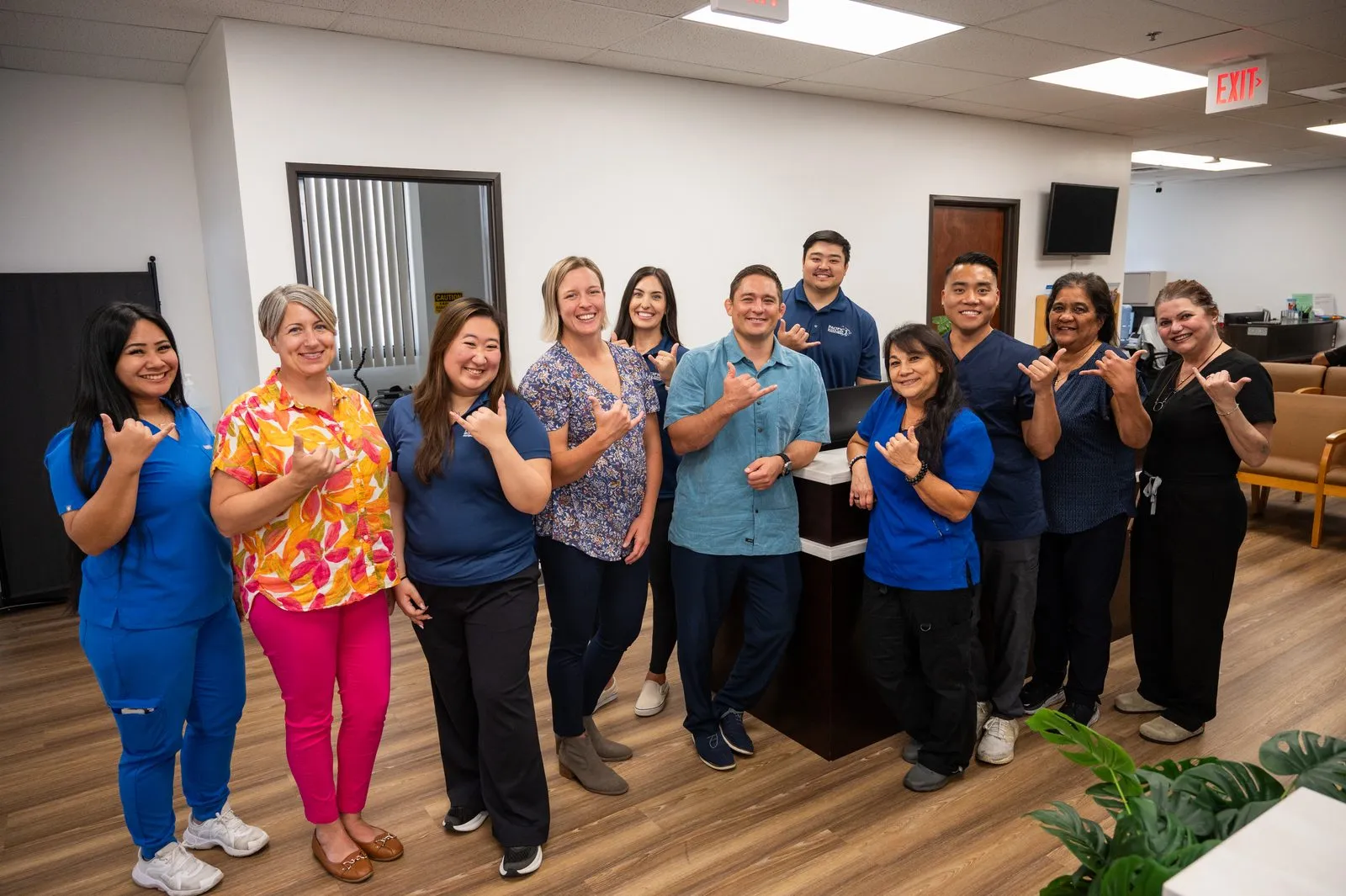
PB&J Physical Therapy works inside our Honolulu and Waipahu/Kunia clinics, so your rehabilitation is planned with the same orthopedic team that treats you. Many orthopedic problems improve with therapy alone, and Hawai‘i allows direct access to physical therapy without a physician referral (some plans still require one for coverage).
PB&J Physical Therapy →Questions, Answered
Partial knee replacement FAQ
How is a partial knee replacement different from a total?+
The knee has three compartments. A total knee replacement resurfaces all of them; a partial (unicompartmental) replacement resurfaces only the one that is worn, keeping your healthy bone, cartilage, and ligaments — including the ACL. Because more of your natural knee is preserved, the incision is smaller and many patients report the knee feels more natural. It is only appropriate when arthritis is truly confined to one compartment.
Am I a candidate for a partial knee?+
Candidacy depends on where your arthritis is, the condition of your ligaments — including an intact ACL — your alignment, and your overall health. If X-rays or an exam show wear beyond one compartment, a total knee replacement is usually the more reliable choice. Only an evaluation with imaging can tell for sure; not everyone is a candidate.
Is the surgery robotic?+
Yes — Dr. Morton performs partial knee replacement with robotic assistance, which builds a plan from your imaging and provides real-time alignment data. On the Big Island, partial knees are performed at Hilo Community Surgery Center with the CT-based MAKO™ system. The robot assists with planning and precision; Dr. Morton controls every step.
Is recovery faster than a total knee replacement?+
Because less bone is removed and less soft tissue is disturbed, recovery after partial knee replacement is often faster in the early weeks than after a total knee, and many eligible patients go home the same day. That said, every recovery is individual — your health, rehab, and goals set the pace.
Will I need a total knee replacement later?+
A partial knee resurfaces only the worn compartment — it does not stop arthritis from developing elsewhere in the knee over time. If that happens, a partial knee can be converted to a total knee replacement. Careful patient selection is how we keep that risk low, and we are honest when a total knee is the better first choice.
Where is partial knee replacement performed?+
On the Big Island, at Hilo Community Surgery Center with MAKO™ CT-based robotic assistance — outpatient, close to home. On Oahu, Dr. Morton operates at The Queen's Medical Center and Adventist Health Castle; the venue and robotic platform are matched to your procedure.
Is your arthritis confined to one part of the knee?
There's one way to know: an evaluation with imaging. We'll tell you honestly whether a partial knee, a total knee, or something non-surgical fits you best.
For medical emergencies, call 911. This page is educational and is not a substitute for medical advice. Not everyone is a candidate; individual results and recovery vary.