
Why Replacements Fail
Finding the "why" comes before any surgery
The right revision plan depends entirely on the reason the joint is failing. These are the most common causes we evaluate.
Loosening
Over time an implant can lose its fixation to bone, causing pain — often with activity or when starting to walk.
Wear & bone loss
Bearing surfaces wear with use. Wear debris can cause inflammation and gradual loss of the bone that supports the implant.
Instability
If the soft tissues no longer balance the joint, a hip can dislocate or a knee can feel wobbly or give way.
Infection
A prosthetic joint infection can appear early or years later. It requires a specific, staged treatment plan — ruling it out is step one of every workup.
Fracture around the implant
A periprosthetic fracture — a break in the bone near a hip or knee implant — often requires surgery that addresses both the fracture and the implant.
Stiffness or unexplained pain
Some replacements simply never felt right. A methodical evaluation looks for a correctable cause before any surgery is considered.
The Workup
A thorough, methodical evaluation
Listen & examine
Your history — when the pain started, what it feels like, how the original surgery went — guides everything that follows.
Rule out infection
Blood tests, and joint aspiration when indicated, help rule infection in or out — because an infected joint is treated very differently from a loose one.
Image & plan
X-rays, and advanced imaging when needed, map implant position, fixation, and bone quality so the surgical plan is made before the operating room.

Why Expertise Matters
Revision is a different operation than the first replacement
More complex by nature
Revision surgery works around prior implants, scar tissue, and often bone loss — and may require specialized revision implants and reconstruction techniques.
Fellowship-trained care
Dr. Morton is fellowship-trained in hip & knee replacement, including revision surgery — the specific training this kind of reconstruction calls for.
Honest expectations
Results of revision surgery are generally good — but typically not equal to a well-functioning primary replacement, and recovery is often longer. We'll tell you what's realistic for your case.
On Oahu, surgery is performed at The Queen's Medical Center or Adventist Health Castle; on the Big Island, at Hilo Community Surgery Center. Educational content only — not a promise of results. Candidacy and outcomes are individualized.

Written and Medically Reviewed By
Paul Norio Morton, MD
Board-certified orthopedic surgeon (American Board of Orthopaedic Surgery). Fellowship-trained; Hawai‘i's first fellowship-trained robotic hip & knee replacement surgeon.
Last reviewed July 2026 · Read Dr. Morton's full bio →
Explore Related Care
Explore related care
Robotic Joint Replacement
Primary hip & knee replacement with robotic assistance.
Explore →Physical Therapy
In-house rehab before and after surgery.
Explore →Bone Health
Stronger bone supports a lasting revision.
Explore →Wiki Wiki Urgent Ortho
Same-day evaluation for a painful or injured joint.
Explore →Honest Expectations
What are the risks of revision joint replacement?
Revision surgery is more complex than a first-time replacement, and the American Academy of Orthopaedic Surgeons notes that complication rates are higher. Knowing why helps you weigh the decision.
Infection
Infection risk is higher after revision than after a primary replacement, especially when the revision is being done because of infection. Treating infection may require a staged approach — removing the implant, a course of antibiotics, then a new implant.
Dislocation or instability
Soft tissues are often weaker after a previous surgery, so the joint — particularly the hip — is more prone to dislocating or feeling unstable. Specialized implants may be used to reduce this risk.
Fracture and bone loss
Bone around an old implant can be thin or damaged. Fracture during removal of the old components, or the need for bone graft and specialized revision implants, is more common than in a first replacement.
Blood clots
Longer operations carry a higher risk of clots in the leg veins, which can travel to the lungs. Blood thinners, compression, and early walking reduce this risk.
Nerve or blood-vessel injury
Scar tissue from prior surgery makes nearby nerves and vessels harder to protect, so injury — while still uncommon — is more likely than in a first replacement.
Longer recovery, persistent pain, further revision
Recovery after revision is usually slower, results are generally less predictable than a first replacement, and some patients eventually need another revision.
How we work to lower your risk
- A thorough workup before surgery — blood tests and joint aspiration when indicated to rule infection in or out, plus detailed imaging of implant position and bone quality
- Advance planning with specialized revision implants, grafts, and fixation options so the right tools are in the room
- Blood-clot prevention, preventive antibiotics, and a structured rehab plan with in-house PB&J Physical Therapy on Oahu
Source: American Academy of Orthopaedic Surgeons, OrthoInfo — Revision Total Hip Replacement and Revision Total Knee Replacement. Every patient’s risk is different. Dr. Morton reviews your individual risks and benefits — based on your health, anatomy, and history — before any decision about surgery.
2-Minute Check
Am I a candidate for revision joint replacement?
Answer a few quick questions. This is educational and is not a diagnosis — only an evaluation can tell for sure.
Do you have hip or knee pain that limits walking, stairs, or sleep?
Have non-surgical treatments (therapy, injections, medication) stopped giving lasting relief?
Have X-rays shown arthritis or joint damage, or has a provider mentioned it?
You may be a strong candidate.
Your answers suggest revision joint replacement could be a good fit. The next step is a simple evaluation, where we'll confirm with an exam and imaging and review every option with you — surgical and non-surgical.
This tool is educational and not a diagnosis. Not everyone is a candidate; only a clinical evaluation can determine what's right for you.
You might be a candidate — let's talk.
Some of your answers point toward revision joint replacement, but the right path depends on the details. A short evaluation will give you a clear, honest answer and a plan.
This tool is educational and not a diagnosis. Not everyone is a candidate; only a clinical evaluation can determine what's right for you.
Let's take a closer look.
Your answers don't point clearly to revision joint replacement yet — but that doesn't mean we can't help. We'll evaluate what's going on and point you to the care that fits, often starting with non-surgical options.
This tool is educational and not a diagnosis. Not everyone is a candidate; only a clinical evaluation can determine what's right for you.
Answer all 3 questions to see your result.
Patient Reviews
What patients say
4.9 average across 509 ratings on 8 review sites
“Dr. Morton has an excellent bedside manner. He really took the time to talk with me about all of my options for my hip replacement. He did my re-do hip replacement 3 months ago and I haven't felt this good for years! Thank you Dr. Morton for helping me walk again.”
— Verified patient· Healthgrades review
“I had knee replacement surgery elsewhere in 2019 and it didn’t go well — over a year and a half of excruciating pain. I was referred to Dr. Morton, he did the surgery, and a week and a half later the pain was completely gone.”
— John H.· Google review
Review excerpts reflect individual patient experiences and may be lightly condensed. Results vary.
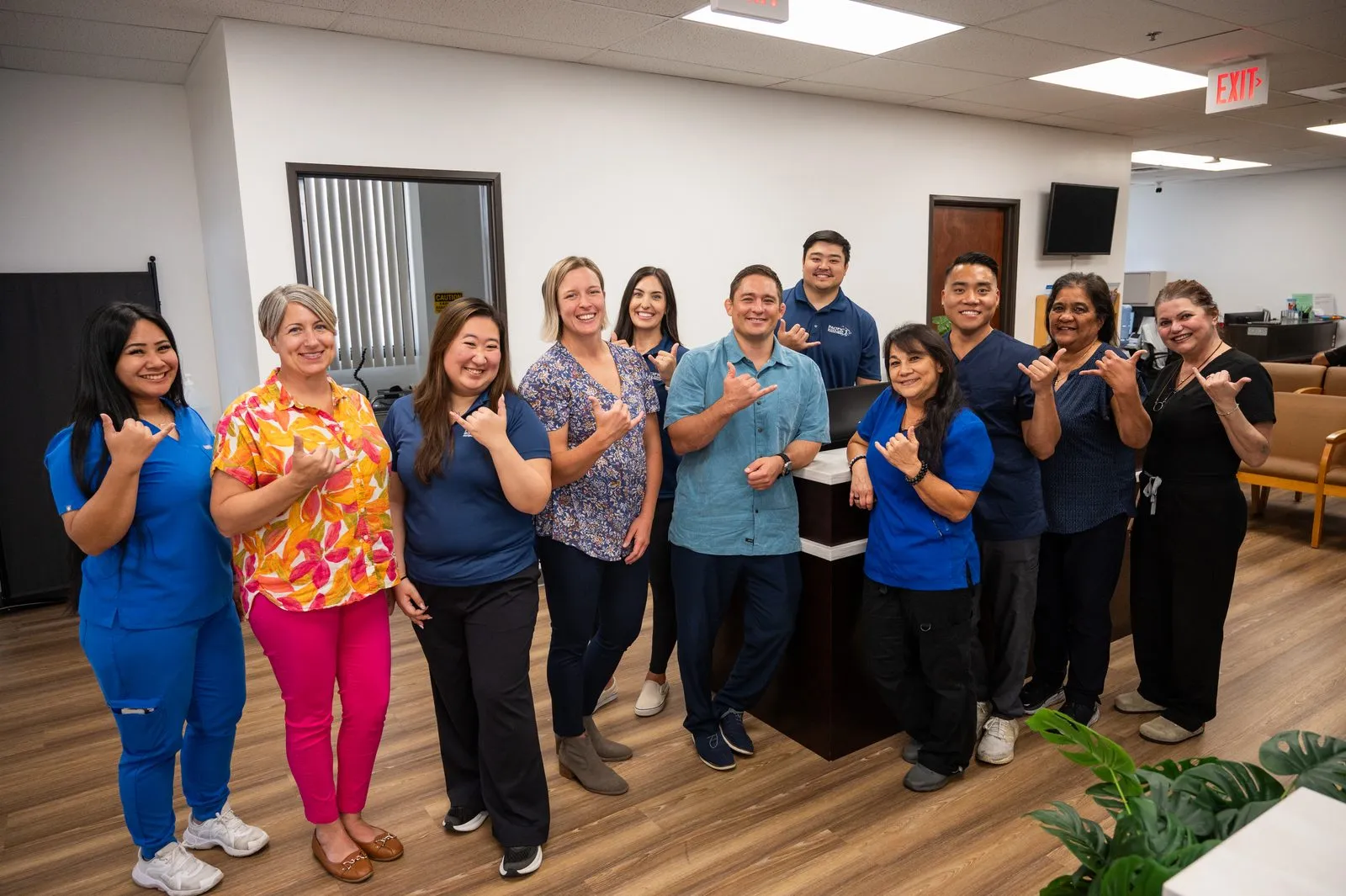
Rehabilitation & Recovery
Physical therapy for revision joint replacement
PB&J Physical Therapy works inside our Honolulu and Waipahu/Kunia clinics, so your rehabilitation is planned with the same orthopedic team that treats you. Many orthopedic problems improve with therapy alone, and Hawai‘i allows direct access to physical therapy without a physician referral (some plans still require one for coverage).
PB&J Physical Therapy →Questions, Answered
Revision joint replacement FAQ
How do I know if my joint replacement has failed?+
Warning signs include new or worsening pain, swelling, instability, or a feeling that the joint has loosened. But only an evaluation — exam, labs, and imaging — can tell whether the implant has actually failed, and why. Some painful replacements have causes that don't require revision surgery.
Why is revision surgery more complex than the original replacement?+
Revision surgery works around scar tissue, prior implants, and often bone loss. It frequently requires specialized implants, careful reconstruction of bone and soft tissue, and longer operative time. That complexity is why fellowship-trained expertise in revision hip and knee surgery matters.
Will a revision feel as good as my first replacement did?+
We'll be honest with you: results of revision surgery are generally good, but they are typically not equal to a well-functioning primary replacement, and recovery is often longer. Setting realistic expectations together is part of the plan. Individual results vary.
What if my joint is infected?+
A prosthetic joint infection is treated very differently from mechanical failure — often with a staged approach coordinated with infectious-disease specialists. That is exactly why every revision workup starts with labs, and joint aspiration when indicated, to rule infection in or out first.
Where is revision surgery performed?+
On Oahu, surgery is performed at The Queen's Medical Center or Adventist Health Castle. On the Big Island, surgery is performed at Hilo Community Surgery Center. The right venue depends on the complexity of your case and your overall health.
Is revision joint replacement covered by insurance?+
Revision surgery for a failed joint replacement is generally covered by most plans, including Medicare, though prior authorization may be required. Our team helps verify benefits before your visit.
Worried about your joint replacement?
Start with an evaluation. We'll find out exactly what's going on with your implant and review every option — including the ones that don't involve surgery.
For medical emergencies, call 911. This page is educational and is not a substitute for medical advice. Not everyone is a candidate; individual results and recovery vary.