

Many patients are surprised when an MRI shows a torn meniscus but their orthopedic surgeon does not immediately recommend arthroscopy. Others have been told that a “clean-out” procedure will wash away arthritis and restore the knee.
The truth is more nuanced.
Knee arthroscopy can be very useful when there is a specific mechanical problem that can be corrected through small incisions. It is much less reliable when the main problem is worn cartilage from osteoarthritis. The key is matching the operation to the diagnosis rather than treating every MRI tear the same way.
From my perspective as an orthopedic surgeon, the most important question is not simply, “Is there a meniscus tear?” It is:
Is the tear truly causing the patient’s symptoms, and is there a correctable mechanical problem inside the knee?
What is knee arthroscopy?
Knee arthroscopy is a minimally invasive operation performed through small incisions. A narrow camera is inserted into the joint, allowing the surgeon to inspect the cartilage, meniscus, ligaments, and joint lining. Small instruments can then be used to repair or trim damaged tissue, remove loose fragments, or treat selected cartilage problems.
Common arthroscopic procedures include:
- Meniscus repair
- Partial meniscectomy, which removes only the unstable torn portion
- Removal of a loose body
- Treatment of certain cartilage injuries
- Synovectomy for selected inflammatory or mechanical conditions
- Treatment of selected ligament injuries
Arthroscopy is not one single operation. Its value depends on what is found and what can realistically be fixed.
Why are meniscus tears so common on MRI?
The meniscus is a crescent-shaped shock absorber between the thighbone and shinbone. With age, it can become less flexible and more prone to fraying. Degenerative tears may develop gradually, sometimes without a memorable injury.
This matters because an MRI abnormality is not always the source of pain. In middle-aged and older adults, degenerative meniscus tears are common and often coexist with cartilage wear. A tear may be present while the dominant pain generator is actually osteoarthritis.
That is why the MRI must be interpreted alongside:
- Where the pain is located
- Whether there was a sudden injury
- Whether the knee truly locks
- Whether the knee repeatedly catches or gives way
- The amount and location of arthritis on weight-bearing X-rays
- The examination findings
- Whether nonsurgical treatment has been tried
An MRI is an important tool, but it should not make the decision by itself.
What does the research show for degenerative meniscus tears?
High-quality trials have repeatedly found that routine arthroscopic partial meniscectomy does not provide a meaningful long-term advantage over exercise-based treatment or even placebo surgery for many middle-aged adults with degenerative meniscus tears.
In the placebo-controlled FIDELITY trial, arthroscopic partial meniscectomy did not produce better patient-reported outcomes than sham surgery for degenerative medial meniscus tears. At five years, the surgery group still had no meaningful symptom advantage and showed a slightly greater progression of radiographic osteoarthritis. Read the five-year FIDELITY follow-up.
The ESCAPE randomized trial compared arthroscopic partial meniscectomy with exercise-based physical therapy in adults age 45 to 70. At five years, physical therapy remained noninferior to surgery for knee function. Read the ESCAPE trial.
A 10-year follow-up of the OMEX randomized trial likewise found no clinically relevant difference in patient-reported outcomes between arthroscopic partial meniscectomy and exercise therapy for degenerative tears. Read the OMEX 10-year follow-up.
Based on this body of evidence, the BMJ Rapid Recommendation issued a strong recommendation against arthroscopy for nearly all patients with degenerative knee disease. Read the BMJ guideline.
This does not mean arthroscopy is never appropriate. It means that pain from a degenerative tear should not automatically lead to surgery.
Why does arthroscopy usually not work well for established arthritis?
Osteoarthritis is a disease of the whole joint. It can involve:
- Loss of articular cartilage
- Bone remodeling and bone spurs
- Meniscus degeneration
- Joint inflammation
- Stiffness and reduced motion
- Changes in muscle strength and movement patterns
An arthroscope can trim a torn meniscus or remove a loose fragment, but it cannot restore broad areas of missing cartilage. It cannot reverse joint-space narrowing, reshape the entire arthritic joint, or reliably eliminate pain coming from exposed or inflamed bone surfaces.
That is why a “clean-out” may provide temporary relief for some patients but often fails to solve the underlying problem. In some cases, removing additional meniscus tissue can reduce the knee’s remaining shock-absorbing capacity.
For patients whose primary symptoms are aching pain, stiffness, swelling, and reduced walking tolerance from moderate or severe arthritis, treatment is usually better directed toward the arthritis itself. This may include medication, injections, activity modification, bracing, weight management, physical therapy, or, when appropriate, knee replacement.
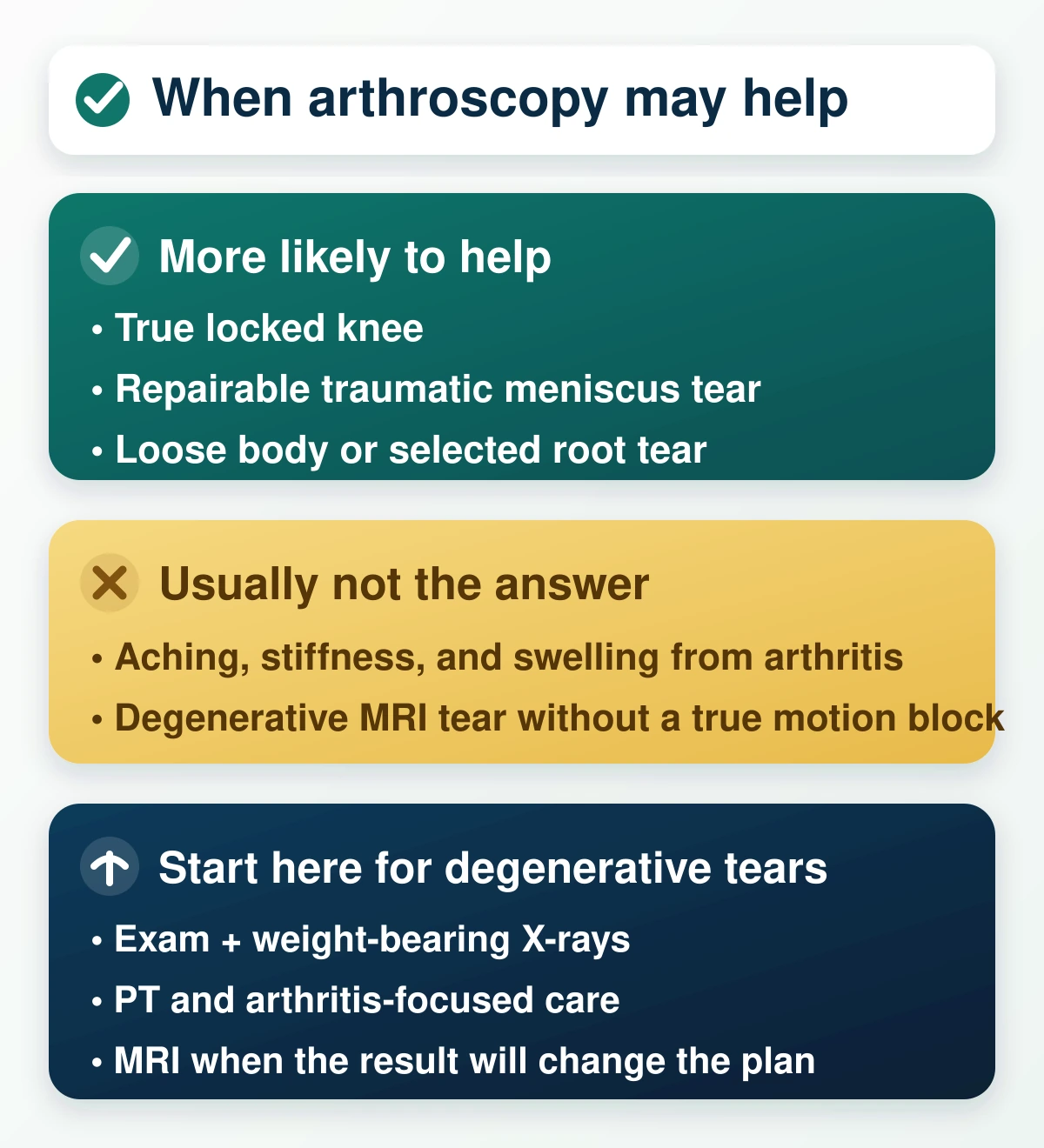
Arthroscopy is most useful for a correctable mechanical problem. It is usually not the best treatment for aching, stiffness, and swelling caused by established arthritis.
When can knee arthroscopy still be helpful?
There are several situations in which arthroscopy may be reasonable or strongly indicated.
1. A true locked knee
A true mechanical lock means the knee physically cannot fully bend or straighten because something is blocking motion. This is different from pain-limited stiffness or a brief catching sensation.
Possible causes include:
- A displaced bucket-handle meniscus tear
- A loose bone or cartilage fragment
- A large unstable flap
- Certain traumatic injuries
A persistently locked knee deserves prompt evaluation because delaying treatment may make repair more difficult in selected cases.
2. A traumatic meniscus tear in a younger or active patient
A sudden twisting injury with immediate pain, swelling, and mechanical symptoms is different from gradual degenerative fraying. In appropriate patients, a repairable traumatic tear may benefit from arthroscopic meniscus repair.
Whenever possible, preserving the meniscus is preferred over removing it. Meniscus repair requires a longer recovery than trimming, but preserving meniscal tissue may better protect the joint over time.
3. A meniscus root tear with mild arthritis
The meniscus root anchors the meniscus to the tibia. A root tear can cause the meniscus to lose its ability to distribute load, which may rapidly increase pressure on the cartilage.
Selected patients with a repairable root tear, relatively preserved cartilage, acceptable alignment, and manageable arthritis may benefit from root repair. Advanced arthritis, severe malalignment, or extensive cartilage loss may make repair less likely to succeed.
This is one of the most important examples of why the exact tear pattern matters.
4. A symptomatic loose body
A loose fragment of cartilage or bone can move around the joint and cause unpredictable catching, locking, or sharp pain. Arthroscopic removal may provide meaningful relief when the loose body matches the symptoms.
5. A focal cartilage injury
A young or active patient with a contained cartilage defect is different from a patient with diffuse osteoarthritis. Arthroscopy may be part of a cartilage-restoration strategy in selected cases, although the best procedure depends on defect size, location, bone involvement, alignment, and activity goals.
6. Infection or selected inflammatory conditions
Arthroscopic irrigation and debridement may be urgently required for a septic knee. Arthroscopy may also be used for selected synovial disorders or inflammatory tissue overgrowth, although these are different from routine arthritis treatment.
What are “mechanical symptoms,” and do they predict success?
Patients often describe clicking, popping, catching, locking, or giving way. These terms can mean very different things.
A painful click does not necessarily mean a meniscus fragment is stuck. Arthritis can create rough surfaces that click or grind. Weakness can make the knee feel unstable. Swelling can temporarily limit motion.
Research has not shown that ordinary self-reported catching or clicking reliably identifies patients with degenerative tears who will benefit from arthroscopic partial meniscectomy. Even the FIDELITY subgroup analyses did not show a clear benefit for patients reporting mechanical symptoms. Read the two-year placebo-controlled follow-up.
The exception is a true objective block to motion, especially after a traumatic injury. That requires a different level of concern than intermittent clicking.
What should be tried before arthroscopy?
For most degenerative meniscus tears without true locking, the initial plan is nonsurgical.
A reasonable program may include:
- Activity modification during a flare
- Anti-inflammatory medication when medically safe
- Ice for swelling
- A structured strengthening and mobility program
- Weight management when excess load is contributing
- A brace for selected patients
- A corticosteroid or other injection when appropriate
Physical therapy focuses on the entire limb, not just the tear. Improving quadriceps strength, hip strength, balance, and movement control can reduce stress across the knee even though the MRI still shows a tear.
Many patients improve enough that surgery is no longer necessary. Others complete a thoughtful nonsurgical trial and still have a focal mechanical problem. At that point, arthroscopy may be reconsidered.
When should an MRI be ordered?
Not every painful knee needs an MRI.
Weight-bearing X-rays are often the best first imaging study for middle-aged and older adults because they show joint-space loss, alignment, bone spurs, and the overall arthritis pattern. An MRI may be helpful when:
- Symptoms began after a significant injury
- The knee is truly locked
- A repairable meniscus tear is suspected
- A root tear is suspected
- X-rays do not explain persistent symptoms
- A cartilage-restoration or ligament procedure is being considered
- Surgery is being planned and the MRI will change the plan
Ordering an MRI too early can create confusion because it frequently identifies age-related findings that are not causing pain.
What are the risks of knee arthroscopy?
Arthroscopy is generally less invasive than open surgery, but it is not risk-free. Potential complications include:
- Infection
- Blood clots
- Bleeding or swelling
- Stiffness
- Persistent pain
- Nerve or blood-vessel injury
- Anesthesia complications
- Failure to improve
- Accelerated symptoms if too much meniscus is removed
The possibility of a small-incision procedure should not make the indication casual. A minimally invasive operation still needs a meaningful expected benefit.
How long is recovery?
Recovery depends on the exact procedure.
After a simple partial meniscectomy, many patients bear weight quickly and return to routine activities over several weeks, although swelling and strength recovery may take longer.
Meniscus repair or root repair is different. These procedures may require restricted weight bearing, a brace, limited knee flexion, and several months before return to impact sports. The longer protection period is intended to allow the repaired tissue to heal.
A patient should understand the planned procedure before surgery. “Arthroscopy” alone does not describe the recovery.
Dr. Morton’s orthopedic perspective
I think of arthroscopy as a precise tool, not a general treatment for every painful knee.
It is most useful when there is a discrete mechanical problem that can be corrected, such as a locked bucket-handle tear, a symptomatic loose body, a repairable traumatic tear, or a selected meniscus root tear in a knee without advanced arthritis.
It is usually disappointing when the main problem is diffuse cartilage loss. In that situation, trimming a degenerative meniscus may change the MRI appearance without changing the biology of the arthritic joint.
The best decision comes from combining the history, examination, weight-bearing X-rays, and MRI findings when needed. The goal is to avoid both unnecessary surgery and unnecessary delay when a repairable injury is present.
Questions to ask before scheduling arthroscopy
- Is my pain coming from the meniscus, arthritis, or both?
- Do I have a traumatic tear or a degenerative tear?
- Is the tear repairable, or would tissue be removed?
- Do I have a true locked knee or only clicking and pain?
- How much arthritis is present on weight-bearing X-rays?
- What nonsurgical treatment should I try first?
- What improvement is realistic from this specific procedure?
- What is the chance that pain will persist because of arthritis?
- What restrictions will I have after surgery?
- Could another treatment better address the main source of pain?
Knee evaluation in Hawai‘i
Pacific Bone & Joint evaluates meniscus tears, knee arthritis, sports injuries, and mechanical knee symptoms across Oahu and Hawai‘i Island. Our team can help determine whether symptoms are more likely to improve with rehabilitation, an injection, cartilage or meniscus preservation, arthroscopy, or arthritis-focused treatment.
Visit our sports medicine service or call (808) 439-6201 to request an appointment in Honolulu, Waipahu, Hilo, or Kona.
This article is educational and does not replace an individualized examination or review of your imaging.
Sources and further reading
- Sihvonen R, et al. Arthroscopic partial meniscectomy versus sham surgery for a degenerative meniscal tear. New England Journal of Medicine. 2013.
- Sihvonen R, et al. Arthroscopic partial meniscectomy for a degenerative meniscus tear: five-year follow-up of the placebo-surgery controlled FIDELITY trial. British Journal of Sports Medicine. 2020.
- Noorduyn JCA, et al. Effect of physical therapy vs arthroscopic partial meniscectomy in people with degenerative meniscal tears: five-year follow-up of the ESCAPE randomized clinical trial. JAMA Network Open. 2022.
- Berg B, et al. Arthroscopic partial meniscectomy versus exercise therapy for degenerative meniscal tears: 10-year follow-up of the OMEX randomized controlled trial. British Journal of Sports Medicine. 2025.
- Siemieniuk RAC, et al. Arthroscopic surgery for degenerative knee arthritis and meniscal tears: a clinical practice guideline. BMJ. 2017.
