

Patients often ask for “a cortisone shot in the shoulder” as though every shoulder injection is the same. It is not.
The shoulder contains several possible pain sources packed into a relatively small area: the ball-and-socket joint, the rotator cuff tendons, the subacromial bursa, the acromioclavicular joint, the biceps tendon, and surrounding muscles. An injection can be very helpful when the medication reaches the structure that is actually causing symptoms. The same injection may be disappointing when the diagnosis or target is wrong.
From my perspective as an orthopedic surgeon, the most important questions are:
What is generating the pain, what is the goal of the injection, and what should happen next if the relief is incomplete or temporary?
A shoulder injection should be part of a treatment plan, not a substitute for one.
What is in a shoulder cortisone injection?
Most therapeutic shoulder injections contain a corticosteroid, often called cortisone, and sometimes a local anesthetic.
The corticosteroid is intended to reduce inflammation. The local anesthetic may provide temporary numbness and can also offer diagnostic information. If pain improves immediately after a carefully targeted injection, that response may support the idea that the injected structure is an important pain source.
The effects are not identical for every patient. Relief may begin within several days, and the duration varies. Some patients obtain meaningful short-term improvement. Others notice little change.
Cortisone does not rebuild a torn tendon, replace missing cartilage, or permanently reverse arthritis.
The target matters: four common shoulder injections
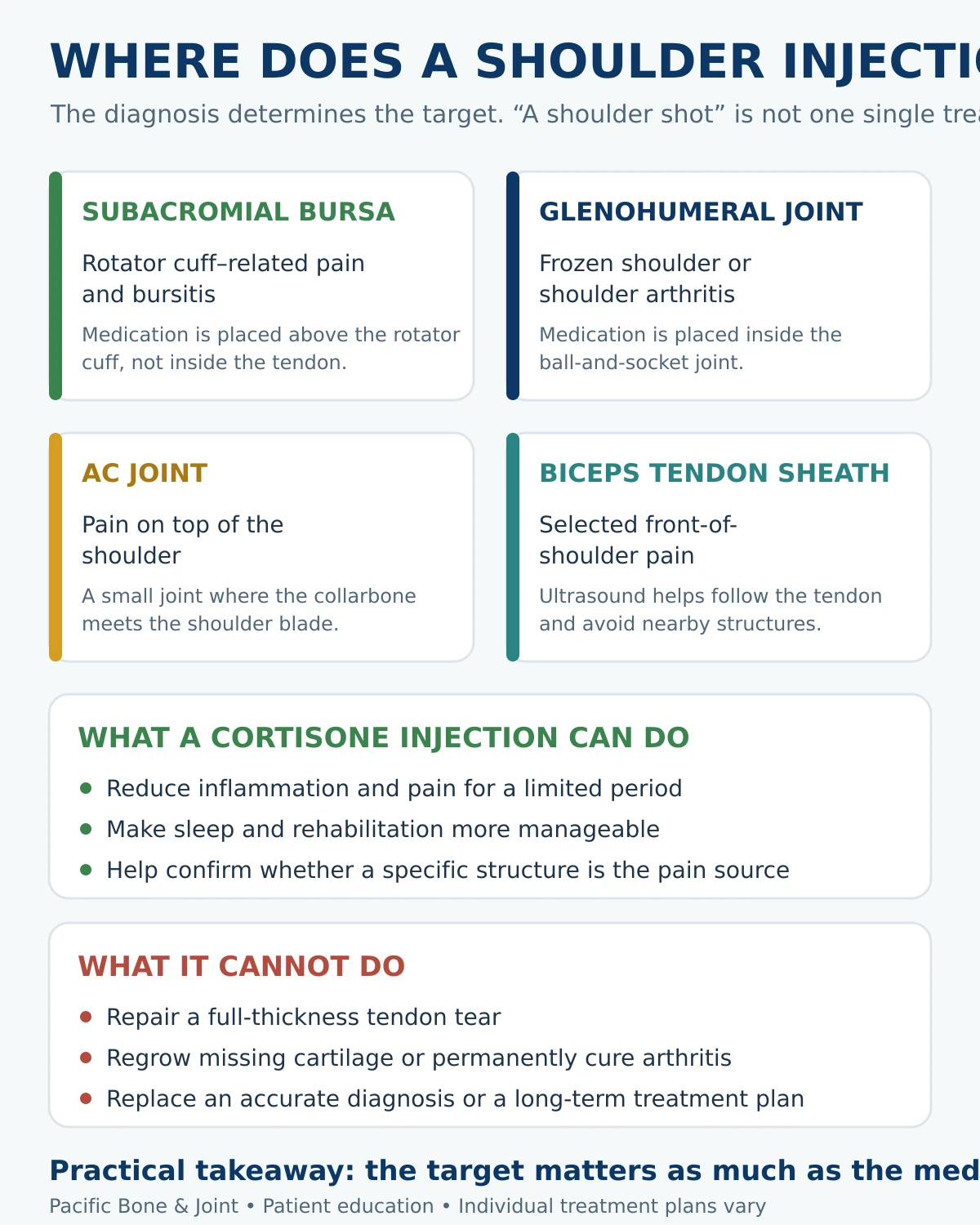
The diagnosis determines the target. A subacromial injection, glenohumeral injection, AC-joint injection, and biceps-sheath injection are different procedures.
1. Subacromial bursa injection
The subacromial bursa lies above the rotator cuff and below the acromion. It helps reduce friction when the arm moves.
A subacromial injection may be considered for selected patients with:
- Rotator cuff–related shoulder pain
- Bursitis
- Painful arc symptoms
- Pain that limits sleep or rehabilitation
- Calcific tendinitis in selected situations
The medication should be placed in the bursal space, not injected into the rotator cuff tendon itself.
Corticosteroid injections for rotator cuff tendinopathy tend to provide their greatest benefit in the short term. A 2025 systematic review found that adding a corticosteroid injection to physical-therapy interventions may produce small to moderate short-term improvements, but injections alone were not a durable replacement for rehabilitation. Read the systematic review.
The updated 2025 American Academy of Orthopaedic Surgeons rotator-cuff guideline addresses corticosteroid injections as one part of evidence-based care. View the AAOS guideline page.
2. Glenohumeral joint injection
The glenohumeral joint is the main ball-and-socket joint.
An injection into this joint may be considered for:
- Frozen shoulder, also called adhesive capsulitis
- Glenohumeral osteoarthritis
- Inflammatory joint irritation
- Diagnostic evaluation when the pain source is uncertain
For frozen shoulder, corticosteroid injection may reduce pain and improve motion most noticeably during the early, painful phase. Systematic reviews have found short-term improvement, especially during the first several weeks, while longer-term outcomes become more similar to other treatments as the condition evolves. Read the systematic review of glenohumeral injections for adhesive capsulitis.
The injection does not “break up” scar tissue. Its purpose is to reduce inflammation and make stretching and rehabilitation more tolerable.
Patients with diabetes should know that corticosteroid can temporarily raise blood glucose. The degree varies, so glucose monitoring and coordination with the clinician managing diabetes may be appropriate.
3. Acromioclavicular joint injection
The acromioclavicular, or AC, joint is the small joint on top of the shoulder where the collarbone meets the acromion.
AC-joint pain is often felt directly on top of the shoulder and may worsen with:
- Reaching across the body
- Push-ups or bench press
- Sleeping on the affected side
- Carrying a heavy bag
- Direct pressure over the joint
A precisely placed injection can serve both a therapeutic and diagnostic role. If pain improves after the AC joint is numbed, it suggests that this small joint is contributing to symptoms.
Because the joint is small, ultrasound guidance can be particularly useful for confirming needle placement.
4. Biceps tendon sheath injection
The long head of the biceps tendon runs through a groove at the front of the shoulder. It may become inflamed by itself or along with rotator cuff or labral disease.
A biceps-sheath injection may be considered when the examination and imaging suggest that the tendon is an important pain source.
The goal is to place medication around the tendon sheath, not into the tendon substance. Ultrasound allows the clinician to identify the tendon, nearby blood vessels, and the path of the needle in real time.
Biceps pain can be difficult to isolate because it frequently coexists with other shoulder problems. An injection should be used carefully as one piece of the diagnostic picture.
Why use ultrasound guidance?
Musculoskeletal ultrasound shows the needle, tendon, bursa, joint, and nearby structures during the procedure. It does not use ionizing radiation.
The practical advantages include:
- Confirming the intended target before the injection
- Watching the needle advance in real time
- Avoiding the tendon when the medication belongs around it
- Identifying fluid, calcification, cysts, or anatomic variation
- Observing the medication spread
- Using the same examination to look for other possible pain sources
A 2025 systematic review found that ultrasound-guided glenohumeral injections were more accurate than landmark-guided injections, although the available trials did not consistently show superior pain and functional outcomes. Read the 2025 systematic review.
A broader systematic review and meta-analysis also found that ultrasound guidance improved several short-term pain and function measures across shoulder conditions, although results varied by diagnosis and injection target. Read the meta-analysis.
This distinction matters: greater accuracy does not guarantee a better outcome when the diagnosis is wrong or the underlying problem cannot be solved by an injection.
What should happen before the injection?
A reasonable shoulder evaluation usually includes:
- A careful history
- Examination of neck and shoulder motion
- Strength testing
- Identification of the exact area of tenderness
- Assessment for stiffness, weakness, instability, or nerve symptoms
- X-rays when arthritis, fracture, calcific deposits, or other bone problems are possible
- Ultrasound or MRI when the result would change treatment
Not every patient needs an MRI before an injection. However, an injection should not be used to repeatedly suppress pain while progressive weakness, trauma, or a possible full-thickness tear goes unexplained.
When may a cortisone injection help?
An injection may be useful when:
- Pain is preventing sleep
- Inflammation is blocking participation in rehabilitation
- Symptoms persist despite appropriate activity modification and medication
- A specific bursa, joint, or tendon sheath appears to be the pain source
- Diagnostic clarification will change the next step
- Surgery is not currently appropriate or desired
For many shoulder conditions, the injection creates a window in which the patient can move more comfortably and rebuild strength. The treatment after the shot often determines whether the improvement lasts.
When is an injection unlikely to solve the problem?
A shoulder injection is less likely to be the definitive answer when symptoms are caused by:
- A large traumatic rotator cuff tear with substantial weakness
- Advanced arthritis with severe loss of joint space
- Recurrent instability or dislocation
- A fracture
- Infection
- A major nerve injury
- Progressive muscle wasting
- A structural problem that requires repair
A meta-analysis of corticosteroid injections for rotator cuff tendinosis found that pain relief was generally small and transient. Repeating the same injection when the first one did not help is unlikely to correct a missed diagnosis. Read the meta-analysis.
How many cortisone shots are too many?
There is no universal number that applies to every patient and every target. The decision depends on:
- The diagnosis
- The structure being injected
- The response to the prior injection
- The time between injections
- Diabetes and other medical conditions
- Tendon quality
- Whether surgery may be needed
- The risks of continuing to mask symptoms
Repeated corticosteroid exposure may weaken tendon tissue, affect cartilage, transiently raise blood glucose, and complicate the timing of surgery. I am cautious about serial injections that provide only brief relief without changing function.
A useful rule is that every repeat injection should have a clear reason. “The pain came back” is not enough by itself. The diagnosis and long-term plan should be reconsidered.
What are the risks?
Possible risks include:
- Temporary soreness or a post-injection flare
- Skin lightening or thinning near the injection site
- Temporary elevation of blood glucose
- Bleeding or bruising
- Allergic reaction
- Infection
- Tendon injury if medication is placed into tendon tissue
- Incomplete or temporary relief
- Rare injury to a nerve or blood vessel
Patients taking blood thinners, those with poorly controlled diabetes, or those with a possible infection need individualized planning.
A rapidly increasing red, hot, swollen shoulder, fever, drainage, or severe pain after an injection requires prompt medical evaluation.
What should I expect afterward?
Instructions vary by the target and diagnosis, but a typical plan may include:
- Relative rest for the remainder of the day
- Ice for short periods if the area is sore
- Avoiding unusually heavy lifting for a brief period
- Resuming prescribed mobility or strengthening when advised
- Monitoring blood glucose more closely if you have diabetes
- Recording how much relief occurred and how long it lasted
The immediate anesthetic effect may wear off before the corticosteroid begins working. That does not automatically mean the injection failed.
The most useful follow-up question is not simply, “Did the shot help?” It is:
Which activities improved, by how much, and for how long?
Is PRP better than cortisone?
Platelet-rich plasma and corticosteroid injections are different treatments with different goals.
Cortisone is primarily anti-inflammatory and often works faster. PRP is intended to influence the local healing environment, and improvement may be slower. Evidence varies by diagnosis, preparation technique, and tendon or joint involved.
Neither treatment is automatically superior for every shoulder problem. The diagnosis, tissue quality, cost, recovery goals, and available evidence should guide the choice.
Dr. Morton’s orthopedic perspective
I do not think of “a shoulder shot” as a generic procedure.
For a painful frozen shoulder, a correctly placed glenohumeral injection may make motion and rehabilitation much more manageable. For subacromial pain, an injection may calm a difficult flare and create an opportunity to strengthen the rotator cuff and shoulder blade muscles. For a small AC joint or biceps tendon sheath, ultrasound guidance can help make the diagnostic information more meaningful.
The injection should have a defined target and purpose.
I become concerned when patients receive repeated injections without a clear diagnosis, when weakness is worsening, or when each shot provides less relief than the one before. At that point, the answer is usually not another identical injection. It is a better evaluation.
Shoulder care in Hawai‘i
Pacific Bone & Joint evaluates shoulder pain, rotator cuff problems, bursitis, frozen shoulder, arthritis, biceps disorders, and sports injuries across Oahu and Hawai‘i Island.
Our team can combine examination, X-rays, musculoskeletal ultrasound, rehabilitation, medication, targeted injection, and surgical consultation when appropriate. Learn more about our shoulder and elbow care and sports medicine services.
Call (808) 439-6201 to request an evaluation in Honolulu, Waipahu, Hilo, or Kona. Kona visits are by appointment only.
This article is educational and does not replace an individualized examination.
Sources and further reading
- American Academy of Orthopaedic Surgeons. Clinical Practice Guideline: Management of Rotator Cuff Injuries. 2025.
- Desmeules F, et al. Effectiveness of additional or standalone corticosteroid injections compared with physical therapist interventions in rotator cuff tendinopathy. Physical Therapy. 2025.
- Mohamadi A, et al. Corticosteroid injections give small and transient pain relief in rotator cuff tendinosis: a meta-analysis. Clinical Orthopaedics and Related Research. 2017.
- Song A, et al. Glenohumeral corticosteroid injections in adhesive capsulitis: a systematic search and review. PM&R. 2014.
- Enriquez R, et al. Accuracy and efficacy of ultrasound-guided glenohumeral joint injections: a systematic review. American Journal of Physical Medicine & Rehabilitation. 2025.
- ElMeligie MM, et al. Systematic review and meta-analysis on ultrasound-guided versus landmark corticosteroid injection for shoulder pain. Journal of Ultrasound. 2023.
