
Why Alignment Matters
A crooked limb overloads one side of the joint
Think of a car with the wheels out of alignment: one tire wears out early. Malalignment does the same thing to cartilage — and these are the common ways it happens.
Bowlegs & knock-knees
Varus (bowleg) or valgus (knock-knee) alignment shifts your body weight onto one side of the knee, so one compartment carries far more than its share of load.
Malunion after fracture
A fracture that healed out of alignment can change how force travels through the limb — sometimes causing pain years after the original injury.
Growth-related deformity
Deformities that develop during childhood growth can persist into adulthood and gradually overload a joint.
How Correction Works
Planned with imaging, corrected with precision
Measure the alignment
Detailed standing alignment X-rays — and advanced imaging when needed — map exactly where your limb axis falls and how much correction would help.
Realign the limb
When surgery is appropriate, an osteotomy — a precise, planned cut and realignment of the bone — shifts weight-bearing off the damaged side of the joint onto healthier cartilage.
Guided recovery
The bone heals in its new, corrected position while physical therapy rebuilds strength and motion — with follow-up imaging along the way.
Often paired with cartilage restoration
In select patients, realignment is combined with cartilage restoration — because a cartilage repair tends to do better when the limb is no longer overloading it. Together they form a joint-preservation plan aimed at delaying or avoiding replacement. Whether that combination fits depends on your alignment, defect, and arthritis status.
An Honest Word on Candidacy
Realignment is powerful — for the right knee
Best fit
Typically younger or active patients with a measurable deformity and damage limited mostly to one side of the joint.
What it can't do
It does not reverse widespread arthritis. When damage involves the whole joint, replacement is usually the more reliable option — and we offer both, so our advice isn't biased toward either.
Non-surgical first
Bracing, physical therapy, activity modification, and injections are part of the conversation before any surgery is considered.
Educational content only; not a promise of results. Bone healing takes time and recovery timelines vary. Candidacy is confirmed with standing alignment imaging and exam.
Why Preserve the Joint
Keeping your natural knee working longer
For active people — hikers, paddlers, workers on their feet — a well-aligned natural joint is worth protecting. Realignment aims to relieve pain in the overloaded compartment and slow further wear, so the activities you love stay on the table.
And if a replacement is ever needed down the road, correcting alignment and preserving bone can keep that door open.


Written and Medically Reviewed By
Paul Norio Morton, MD
Board-certified orthopedic surgeon (American Board of Orthopaedic Surgery). Fellowship-trained; Hawai‘i's first fellowship-trained robotic hip & knee replacement surgeon.
Last reviewed July 2026 · Read Dr. Morton's full bio →
Explore Related Care
Explore related care
Cartilage Restoration
MACI, CartiHeal & OATS — often paired with realignment.
Explore →Robotic Joint Replacement
When arthritis is too advanced to preserve the joint.
Explore →Physical Therapy
In-house rehab through every stage of recovery.
Explore →Sports Medicine
Non-surgical care for active knees.
Explore →Limb Deformity Correction: Treatment Outcomes
Evidence-based results for realignment (osteotomy) procedures.
2-Minute Check
Am I a candidate for limb deformity correction?
Answer a few quick questions. This is educational and is not a diagnosis — only an evaluation can tell for sure.
Do you have pain or a problem limiting your daily activities?
Have basic measures not given you lasting relief?
Would you like an expert opinion on your options?
You may be a strong candidate.
Your answers suggest limb deformity correction could be a good fit. The next step is a simple evaluation, where we'll confirm with an exam and imaging and review every option with you — surgical and non-surgical.
This tool is educational and not a diagnosis. Not everyone is a candidate; only a clinical evaluation can determine what's right for you.
You might be a candidate — let's talk.
Some of your answers point toward limb deformity correction, but the right path depends on the details. A short evaluation will give you a clear, honest answer and a plan.
This tool is educational and not a diagnosis. Not everyone is a candidate; only a clinical evaluation can determine what's right for you.
Let's take a closer look.
Your answers don't point clearly to limb deformity correction yet — but that doesn't mean we can't help. We'll evaluate what's going on and point you to the care that fits, often starting with non-surgical options.
This tool is educational and not a diagnosis. Not everyone is a candidate; only a clinical evaluation can determine what's right for you.
Answer all 3 questions to see your result.
Patient Reviews
What patients say
4.9 average across 509 ratings on 8 review sites
“He corrected a full knee replacement that was not done correctly by another doctor — including my thinning bone and my bowlegs. I am so grateful for what he has done for me.”
— Lydia T.· Google review
Review excerpts reflect individual patient experiences and may be lightly condensed. Results vary.
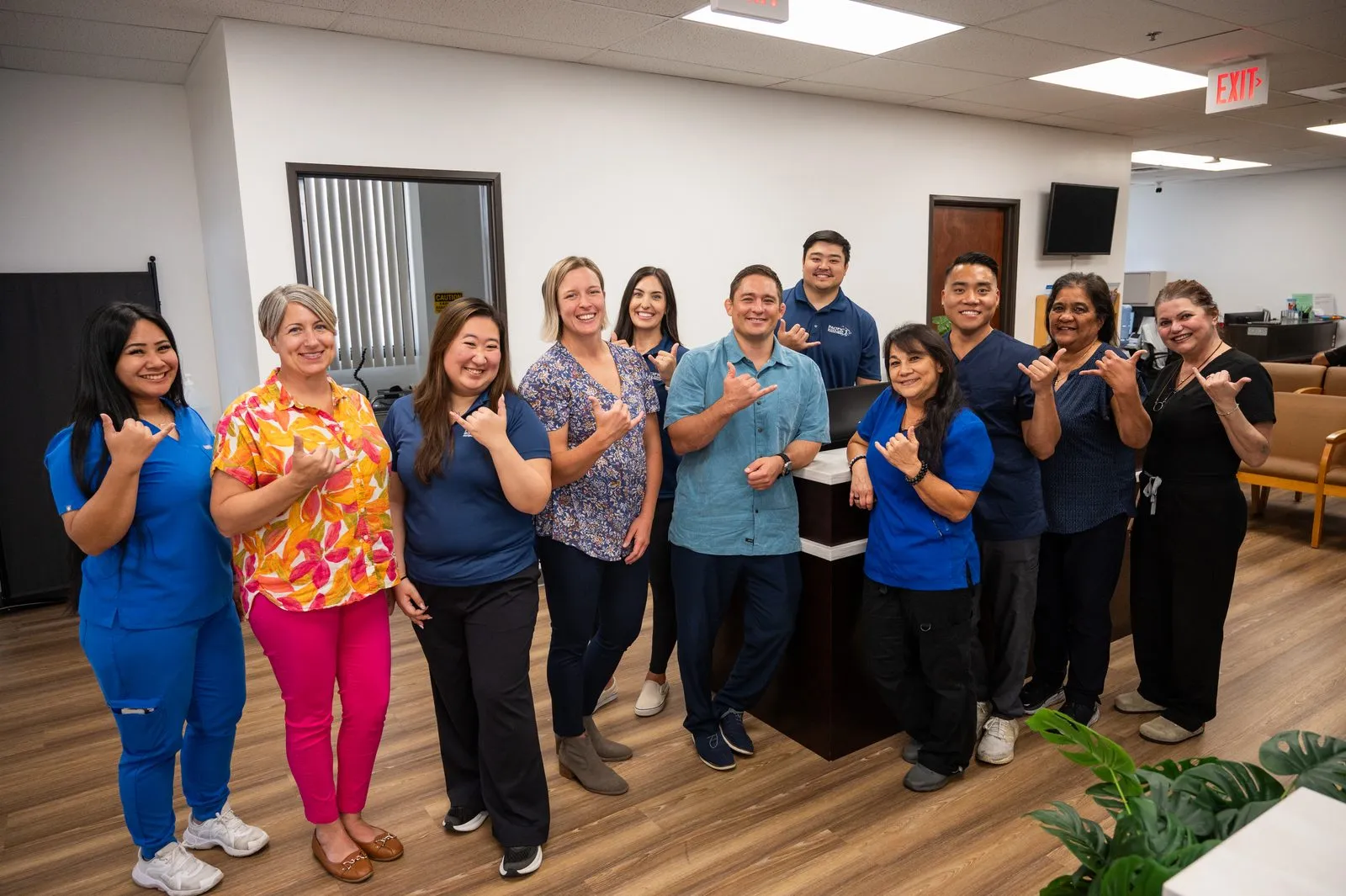
Rehabilitation & Recovery
Physical therapy for deformity correction
PB&J Physical Therapy works inside our Honolulu and Waipahu/Kunia clinics, so your rehabilitation is planned with the same orthopedic team that treats you. Many orthopedic problems improve with therapy alone, and Hawai‘i allows direct access to physical therapy without a physician referral (some plans still require one for coverage).
PB&J Physical Therapy →Questions, Answered
Limb deformity correction FAQ
Why does limb alignment matter for my knee?+
When the limb is malaligned, your body weight travels through one side of the knee instead of being shared evenly. That overloaded compartment wears faster, which can accelerate arthritis on that side while the rest of the joint stays relatively healthy.
What is an osteotomy?+
An osteotomy is a planned surgical realignment of the bone: the bone is precisely cut and repositioned so the limb carries weight through a straighter axis, then stabilized while it heals. The goal is to shift load off damaged cartilage and onto the healthier side of the joint.
Is deformity correction a way to avoid a knee replacement?+
For the right patient, realignment is joint-preserving — it aims to relieve pain and slow arthritis in the overloaded compartment, which may delay or avoid replacement. It works best when damage is limited to one side of the joint. It is not a cure for widespread arthritis, and some patients may still need a replacement later. Individual results vary.
Can realignment be combined with cartilage restoration?+
Yes — in select patients, correcting alignment and restoring cartilage are done as a coordinated plan, because cartilage repair tends to do better when the limb is no longer overloading it. Whether that applies to you depends on your alignment, defect, and arthritis status.
How do you decide if I am a candidate?+
Candidacy depends on where the damage is, how much deformity is present, your age and activity level, bone quality, and your goals. We start with standing alignment X-rays and a careful exam, then walk through the options honestly — surgical and non-surgical. Not everyone is a candidate.
Wondering if alignment is behind your knee pain?
Start with an evaluation. Standing alignment X-rays and a careful exam will show us where your limb axis falls — and we'll review every option, surgical and non-surgical.
For medical emergencies, call 911. This page is educational and is not a substitute for medical advice. Not everyone is a candidate; individual results and recovery vary.