
Waipahu · Oahu
Robotic Hip Replacement for Waipahu Patients
Serving Waipahu, Kapolei, Ewa and Central/Leeward Oahu. Robotic-assisted hip replacement pairs precise 3D planning with the muscle-sparing anterior (bikini) approach — designed for accurate implant positioning and a faster, more confident recovery.
Kunia Shopping Center, 94-673 Kupuohi St
- Anterior (bikini) muscle-sparing approach
- Robotic 3D planning for leg-length & alignment
- Cementless, biologic fixation options
- Same-day discharge for eligible patients
 Written and medically reviewed by Paul Norio Morton, MD, FAAOS, FAAHKS · Board-certified orthopedic surgeon · Last reviewed July 2026
How It Works
How robotic-assisted hip replacement works
The robot is a tool that helps Dr. Morton plan and execute your procedure precisely. It assists the surgeon — it does not perform surgery on its own.
3D plan from your CT
A pre-operative CT builds a 3D model of your hip, so implant size, leg length, and alignment are planned to your anatomy with the MAKO™ system.
Surgeon-controlled precision
Dr. Morton uses the system's real-time data to position the socket and stem accurately, helping restore leg length and reduce the risk of dislocation.
Anterior, muscle-sparing
Where appropriate, the anterior (bikini) approach works between muscles rather than cutting through them — designed to support a quicker early recovery. Recovery varies.
Guided recovery
You're up and moving soon after surgery with a plan from our in-house PB&J Physical Therapy team — close to home in Central and Leeward Oahu.
Where Your Care Happens
Local clinic, expert surgery
Robotic-assisted hip replacement is currently performed at Hilo Community Surgery Center with the MAKO™ CT-based system, using the muscle-sparing anterior (bikini) approach. Consults, imaging, and follow-up stay at our Waipahu clinic, and anterior hip replacement without robotic assistance is available at O‘ahu hospitals.
Anterior (bikini) hip · outpatient
Is It Right For You?
Who is a candidate for hip replacement
Hip replacement is usually considered for advanced arthritis when non-surgical care — activity changes, therapy, medication, and injections — no longer gives lasting relief. The American Academy of Orthopaedic Surgeons notes that the decision is based on your pain and loss of function, not your age.
Because we offer both surgical and non-surgical care, Dr. Morton will review every option honestly and recommend surgery only when it is the right fit. Not everyone is a candidate.
You may be a candidate if
- Hip or groin pain limits walking, stairs, or sleep
- Stiffness makes putting on shoes or socks hard
- Non-surgical care no longer gives lasting relief
- X-rays show arthritis or joint damage
What To Expect
From evaluation to recovery
Timelines are general and vary by patient.
Before surgery
An evaluation and X-rays confirm the diagnosis. If you proceed, a pre-operative CT builds your 3D plan, and we coordinate medical clearance and prehab exercises to prepare.
Day of surgery
Robotic hip replacement takes place at Hilo Community Surgery Center, an outpatient center. If you choose surgery on O‘ahu instead, it takes place at an O‘ahu hospital.
Recovery
You begin moving soon after surgery with guidance from our in-house PB&J Physical Therapy team, coordinating your rehab on Oahu — convenient to Kapolei, ʻEwa, and Mililani.

Two nights near Hilo Community Surgery Center
O‘ahu patients who choose robotic hip replacement travel to Hilo for surgery. Consults and follow-up stay at your home clinic on O‘ahu.
The night before
We prefer that you stay near the surgery center in Hilo the night before surgery. Surgery times can change, sometimes on short notice, and being close by means you are not rushing in the morning.
The night after
Plan to spend the night after surgery nearby as well, even if you go home from the surgery center in Hilo the same day, so you are close by if anything comes up that first evening.
Your ride home
Every patient must be driven home after surgery by a family member or friend. You cannot drive yourself home.
Many follow-up visits can be done by video, so once you are home you may not need to travel back for every check-in. Dr. Morton will let you know which visits need to be in person.
Hip Replacement by the Numbers
What published registry data and peer-reviewed research show about modern hip replacement.
Your Surgical Options
Robotic hip in Hilo, or anterior hip on O‘ahu
Robotic-assisted hip replacement is currently performed only at Hilo Community Surgery Center. Waipahu patients can travel to Hilo for robotic surgery or have an anterior hip replacement at an O‘ahu hospital. Either way, consults, imaging, follow-up, and physical therapy stay close to home.
Robotic hip in Hilo
MAKO™ CT-based robotic hip replacement is performed at Hilo Community Surgery Center, an outpatient center on Hawai‘i Island.
Anterior hip on O‘ahu
Muscle-sparing anterior (bikini) hip replacement without robotic assistance is performed at O‘ahu hospitals when staying on O‘ahu fits you better.
Surgeon-led
Dr. Morton directs the plan, the technology, and your care from evaluation through recovery.
Close to home
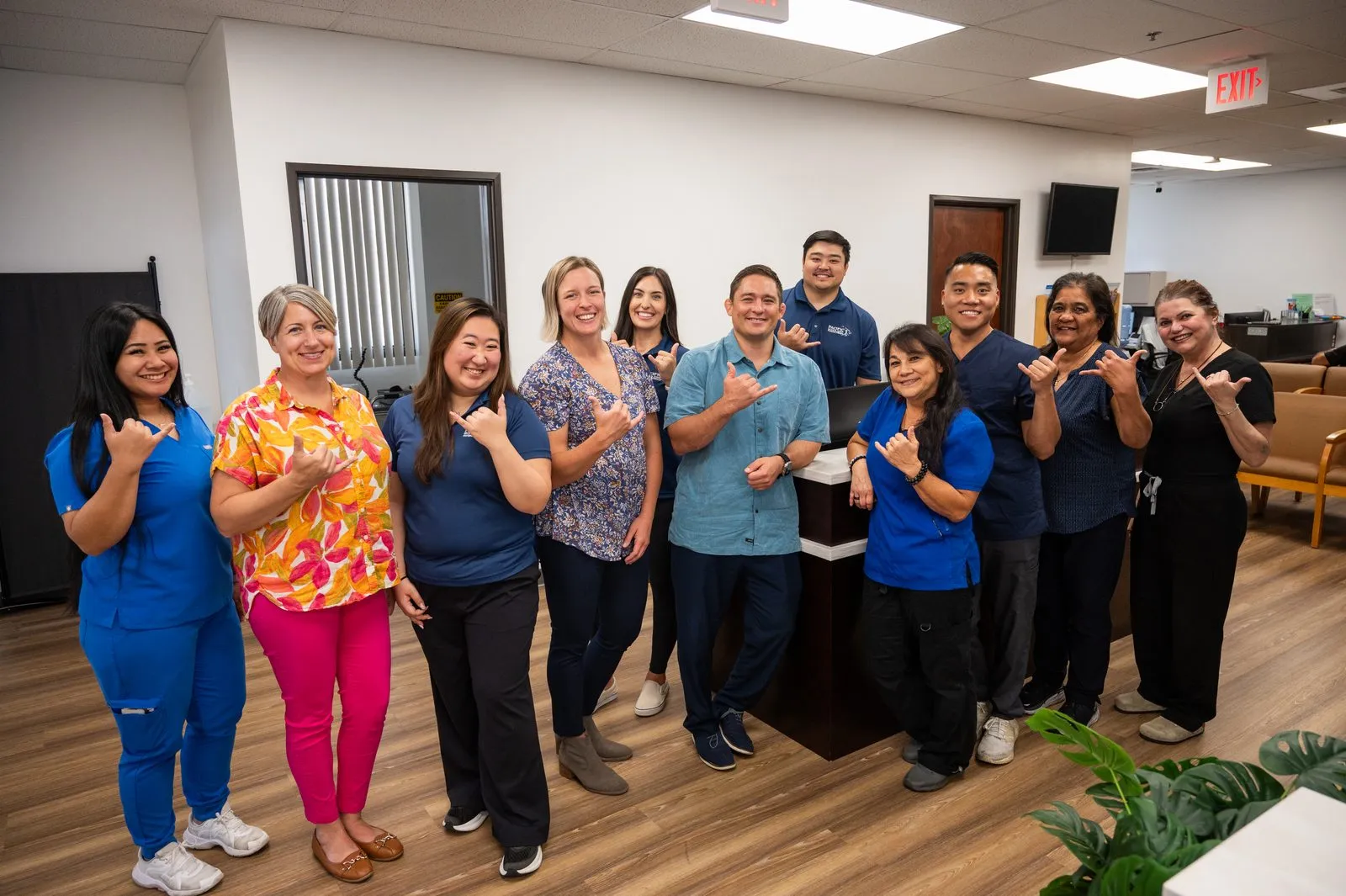
Our Waipahu clinic at Kunia Shopping Center keeps consults and follow-up convenient for Kapolei, ʻEwa, and Mililani.
2-Minute Check
Am I a candidate for robotic hip replacement?
Answer a few quick questions. This is educational and is not a diagnosis — only an evaluation can tell for sure.
Do you have hip or knee pain that limits walking, stairs, or sleep?
Have non-surgical treatments (therapy, injections, medication) stopped giving lasting relief?
Have X-rays shown arthritis or joint damage, or has a provider mentioned it?
You may be a strong candidate.
Your answers suggest robotic hip replacement could be a good fit. The next step is a simple evaluation, where we'll confirm with an exam and imaging and review every option with you — surgical and non-surgical.
This tool is educational and not a diagnosis. Not everyone is a candidate; only a clinical evaluation can determine what's right for you.
You might be a candidate — let's talk.
Some of your answers point toward robotic hip replacement, but the right path depends on the details. A short evaluation will give you a clear, honest answer and a plan.
This tool is educational and not a diagnosis. Not everyone is a candidate; only a clinical evaluation can determine what's right for you.
Let's take a closer look.
Your answers don't point clearly to robotic hip replacement yet — but that doesn't mean we can't help. We'll evaluate what's going on and point you to the care that fits, often starting with non-surgical options.
This tool is educational and not a diagnosis. Not everyone is a candidate; only a clinical evaluation can determine what's right for you.
Answer all 3 questions to see your result.
Rehabilitation & Recovery
Physical therapy for hip replacement
PB&J Physical Therapy works inside our Honolulu and Waipahu/Kunia clinics, so your rehabilitation is planned with the same orthopedic team that treats you. Many orthopedic problems improve with therapy alone, and Hawai‘i allows direct access to physical therapy without a physician referral (some plans still require one for coverage).
PB&J Physical Therapy →Common Questions
Robotic hip replacement in Waipahu: your questions answered
Where is robotic hip replacement performed for Waipahu patients?+
Robotic hip replacement for Waipahu patients is performed at Hilo Community Surgery Center on Hawai‘i Island with the MAKO™ robotic system. Consults, imaging, and follow-up visits happen at our Waipahu clinic.
Does the robot perform my hip surgery?+
No. Dr. Morton controls every step of your hip replacement. The robotic system is a surgical assistant that builds a 3D plan from your imaging and provides real-time alignment data so the implant is positioned according to the plan — it does not operate on its own.
Am I a candidate for robotic hip replacement?+
Candidacy depends on your diagnosis, the degree of joint damage, your overall health, and whether non-surgical care has stopped giving lasting relief. The American Academy of Orthopaedic Surgeons notes that the decision is based on pain and loss of function, not age. Not everyone is a candidate, and Dr. Morton reviews non-surgical options honestly before recommending surgery.
Will I go home the same day, and who handles my rehab in Waipahu?+
Robotic hip replacement at Hilo Community Surgery Center is outpatient, and many healthy patients go home the same day; eligibility depends on your health and support at home. Back on O‘ahu, your rehabilitation runs with our in-house PB&J Physical Therapy team, working from the same recovery protocol as your surgeon.
Evidence & Research
What the evidence says about robotic-assisted hip replacement
Robotic assistance and the muscle-sparing anterior approach are tools that help the surgeon plan and position your implant. Here is a plain-language summary of what peer-reviewed research and the American Academy of Orthopaedic Surgeons report — with the honest limits.
Total hip replacement is one of the most successful operations in modern medicine — it reliably relieves arthritis pain and restores mobility for the great majority of patients.1
It is also durable. The American Academy of Orthopaedic Surgeons reports that the majority of hip replacements continue to function well many years after surgery, and that serious complications are uncommon.2
Robotic assistance is designed to improve accuracy. In a systematic review and meta-analysis, robotic-arm–assisted hip replacement was associated with more accurate placement of the socket within the target ("safe") zone than manual technique.3
The muscle-sparing anterior approach may support faster recovery in the first few weeks, though differences between approaches tend to even out within a few months. Recovery varies for every patient.4
Robotic technology assists the surgeon; it does not perform surgery on its own. Comparisons are to conventional (non-robotic) technique only. Not everyone is a candidate, and individual results and recovery vary. This page is educational and is not a substitute for medical advice.
References
- Learmonth ID, Young C, Rorabeck C. The operation of the century: total hip replacement. Lancet. 2007;370(9597):1508–1519. View source ↗
- American Academy of Orthopaedic Surgeons (AAOS), OrthoInfo. Total Hip Replacement. Accessed 2026. View source ↗
- Han PF, Chen CL, Zhang ZL, et al. Robotics-assisted versus conventional manual approaches for total hip arthroplasty: a systematic review and meta-analysis of comparative studies. Int J Med Robot. 2019;15(3):e1990. View source ↗
- Higgins BT, Barlow DR, Heagerty NE, Lin TJ. Anterior vs. posterior approach for total hip arthroplasty, a systematic review and meta-analysis. J Arthroplasty. 2015;30(3):419–434. View source ↗

Written and Medically Reviewed By
Paul Norio Morton, MD
Board-certified orthopedic surgeon (American Board of Orthopaedic Surgery). Fellowship-trained; Hawai‘i's first fellowship-trained robotic hip & knee replacement surgeon.
Last reviewed July 2026 · Read Dr. Morton's full bio →
Explore More
Robotic Hip Replacement across Hawai‘i
Patient Reviews
What patients say
4.9 average across 509 ratings on 8 review sites
“Dr. Morton is the best. He did my hip replacement and carpal tunnel surgeries. I would not use anyone else.”
— Stephen P.· Google review
“Dr. Paul Morton performed my anterior hip replacement, and the entire experience exceeded my expectations. I went home the same day, was off my walker within a day and a half, off my cane after just five days, and was walking up and down stairs normally 10 days after surgery. I know everyone’s recovery is different. The pain that had been limiting my life is gone.”
— Jason B.· Google review
Review excerpts reflect individual patient experiences and may be lightly condensed. Results vary.
Robotic Hip Replacement in Waipahu starts with an evaluation
Request an appointment on Klara or call (808) 439-6201 — we'll confirm whether this is right for you.