
Where Inequality Comes From
Why one limb ends up shorter
Small side-to-side differences are common and usually harmless. Meaningful inequality typically traces back to one of these causes — and often travels together with an alignment problem, which is why we measure both.
Congenital differences
Some people are born with one limb shorter than the other, and the difference can become more noticeable as growth finishes.
Growth disturbance after injury
A childhood fracture that involves the growth plate — or a bone infection during growth — can slow one limb’s growth, leaving a discrepancy that persists into adulthood.
Prior surgery or trauma
Bone loss from a severe fracture, a fracture that healed short, or previous surgery can shorten a limb — sometimes alongside an alignment problem.
How Lengthening Works
Your own bone does the building — gradually
Measure honestly
Standing alignment X-rays measure the true difference and show where it comes from — the thigh, the shin, or both — and whether alignment needs correcting at the same time.
Lengthen gradually
When lengthening is appropriate, the bone is divided with a planned osteotomy and then slowly distracted — typically with an internal lengthening device — a fraction of a millimeter at a time, so new bone forms in the gap as length is restored.
Rebuild through therapy
Muscles, tendons, and joints have to adapt as the bone lengthens. Physical therapy runs throughout — during lengthening and while the new bone hardens — and is as important to the result as the surgery itself.
Length and alignment are planned together
A short limb is often also a crooked one — after a fracture that healed short or out of alignment, for example. In those cases, lengthening is planned together with deformity correction so the limb ends up both straight and even — one coordinated reconstruction rather than two separate surgeries.
An Honest Word on Candidacy
The simplest option that works is the right one
Non-surgical first
Small differences are common and often need no treatment at all. A shoe lift and observation are the honest starting point — and for many people, the ending point too.
Best fit
Typically patients with a meaningful, well-measured inequality that clearly affects function, good healing biology, and the ability to commit to months of gradual lengthening and therapy.
What it asks of you
This is a months-long process, not a single event — gradual lengthening, then time for the new bone to harden, with physical therapy and follow-up imaging throughout. We will be candid about that before anything is scheduled.
Educational content only; not a promise of results. Lengthening timelines and outcomes vary from person to person. Candidacy is confirmed with standing alignment imaging and exam — and not everyone is a candidate.
Why Balance Matters
Walking evenly changes everything downstream
Every step you take travels up the chain — through the knee, hip, pelvis, and spine. When the limbs are balanced, that load is shared the way it was designed to be. For people whose inequality has meant a limp, fatigue on trails, or nagging back and hip pain, restoring balance is really about restoring how they move through their day.
Rehabilitation with physical therapy is woven through the entire process — keeping joints moving and muscles strong while the new bone forms, so the length you gain becomes function you can use.


Written and Medically Reviewed By
Paul Norio Morton, MD
Board-certified orthopedic surgeon (American Board of Orthopaedic Surgery). Fellowship-trained; Hawai‘i's first fellowship-trained robotic hip & knee replacement surgeon.
Last reviewed July 2026 · Read Dr. Morton's full bio →
Explore Related Care
Explore related care
Limb Deformity Correction
Realignment (osteotomy) — often planned together with lengthening.
Explore →Malunion & Nonunion Repair
When a fracture healed short, crooked, or not at all.
Explore →Physical Therapy
In-house rehab — essential through every stage of lengthening.
Explore →Fracture Care
Treatment of new fractures, simple to complex.
Explore →Limb Lengthening: Treatment Outcomes
Evidence-based results for gradual limb lengthening procedures.
2-Minute Check
Am I a candidate for limb lengthening?
Answer a few quick questions. This is educational and is not a diagnosis — only an evaluation can tell for sure.
Do you have pain or a problem limiting your daily activities?
Have basic measures not given you lasting relief?
Would you like an expert opinion on your options?
You may be a strong candidate.
Your answers suggest limb lengthening could be a good fit. The next step is a simple evaluation, where we'll confirm with an exam and imaging and review every option with you — surgical and non-surgical.
This tool is educational and not a diagnosis. Not everyone is a candidate; only a clinical evaluation can determine what's right for you.
You might be a candidate — let's talk.
Some of your answers point toward limb lengthening, but the right path depends on the details. A short evaluation will give you a clear, honest answer and a plan.
This tool is educational and not a diagnosis. Not everyone is a candidate; only a clinical evaluation can determine what's right for you.
Let's take a closer look.
Your answers don't point clearly to limb lengthening yet — but that doesn't mean we can't help. We'll evaluate what's going on and point you to the care that fits, often starting with non-surgical options.
This tool is educational and not a diagnosis. Not everyone is a candidate; only a clinical evaluation can determine what's right for you.
Answer all 3 questions to see your result.
Patient Reviews
What patients say
4.9 average across 509 ratings on 8 review sites
“He corrected a full knee replacement that was not done correctly by another doctor — including my thinning bone and my bowlegs. I am so grateful for what he has done for me.”
— Lydia T.· Google review
Review excerpts reflect individual patient experiences and may be lightly condensed. Results vary.
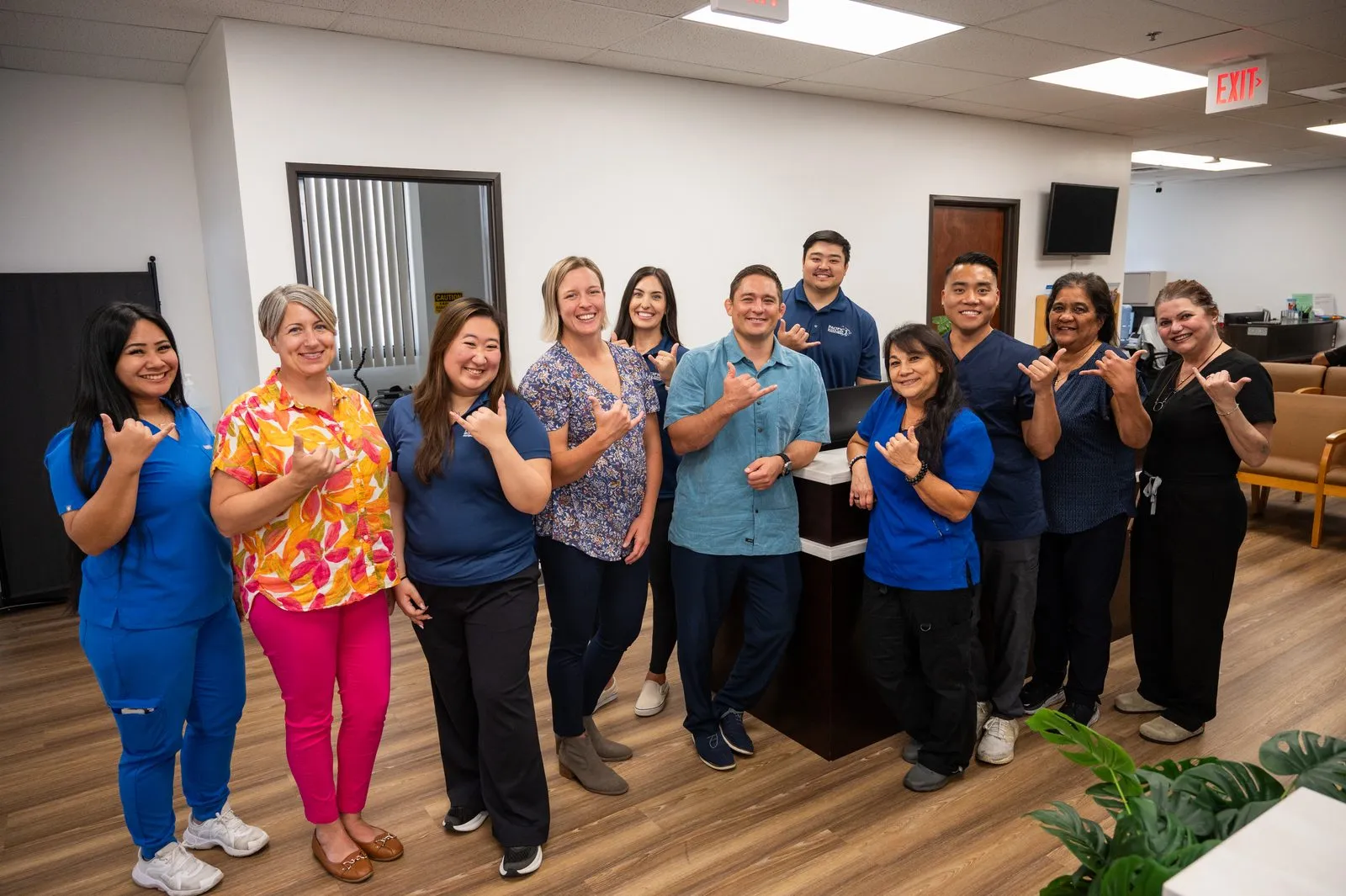
Rehabilitation & Recovery
Physical therapy for limb lengthening
PB&J Physical Therapy works inside our Honolulu and Waipahu/Kunia clinics, so your rehabilitation is planned with the same orthopedic team that treats you. Many orthopedic problems improve with therapy alone, and Hawai‘i allows direct access to physical therapy without a physician referral (some plans still require one for coverage).
PB&J Physical Therapy →Questions, Answered
Limb lengthening FAQ
How much leg-length difference actually matters?+
Small differences are common in the general population, and most cause no symptoms and need no treatment at all. Whether a difference matters depends less on the number and more on you — your symptoms, gait, and function. Many people do well with a simple shoe lift or no treatment; lengthening is reserved for meaningful inequality that affects function.
What problems can a significant discrepancy cause?+
A meaningful difference can change the way you walk, tilt the pelvis, and place uneven demands on the back, hips, and knees — which for some people means a limp, fatigue, or back and hip pain. Part of the evaluation is sorting out how much of your symptoms actually trace back to the length difference.
How does limb lengthening work?+
The bone is divided with a planned surgical cut (osteotomy), and a lengthening device — in modern practice, typically an internal device inside the bone — gradually pulls the two ends apart a fraction of a millimeter at a time. Bone naturally forms in the slowly widening gap, and the soft tissues stretch and adapt as length is restored. This gradual process is the same biology your bone uses to heal a fracture.
How long does the process take?+
This is a commitment measured in months, not weeks. Lengthening itself proceeds gradually, and the new bone then needs additional time to harden before it can take full load. Physical therapy continues throughout, and follow-up visits with imaging track progress at every stage. Exact timelines depend on how much length is needed and how your bone responds — we will be honest about that range before anything is scheduled.
Am I a candidate for limb lengthening?+
Candidacy is individualized. It depends on the size and source of the discrepancy, your symptoms, bone quality and healing biology, your overall health, and — importantly — your ability to commit to months of gradual lengthening and therapy. Simpler options like shoe lifts are always part of the conversation first. Not everyone is a candidate, and we will tell you honestly if you are not.
Where is surgery performed?+
Limb lengthening is complex surgery, and the right venue depends on your case — on Oahu, Dr. Morton operates at The Queen’s Medical Center and Adventist Health Castle. Clinics in Honolulu, Waipahu, Hilo, and Kona handle evaluation and follow-up, so most of the journey happens close to home. Individual results vary.
Wondering if a length difference is behind your symptoms?
Start with an evaluation. Standing alignment X-rays will measure the true difference — and we'll review every option honestly, from a simple shoe lift to gradual lengthening.
For medical emergencies, call 911. This page is educational and is not a substitute for medical advice. Not everyone is a candidate; individual results and recovery vary.